High school teachers test AI tools to enhance their teaching strategies
As artificial intelligence reshapes how we all live, learn and work, The Ohio State University has committed to serving as a national leader in responsible AI innovation.
With more than $235 million in AI research funding, 600+ federal awards and 300+ faculty members conducting AI research, Ohio State is leading research and development in areas such as trustworthy AI, foundational AI, AI‑enabled tools and the development of an AI‑ready talent pipeline.
At the Center on Education and Training for Employment (CETE), a translational research center in the College of Education and Human Ecology, these priorities are leading to real-world impact. CETE steers hands-on professional learning, family-centered activities and community-driven capacity building to advance AI literacy across Ohio.
Beyond these efforts, CETE is also establishing itself as a thought leader in AI in education and training through the work of its ad hoc research group dedicated to this emerging area.
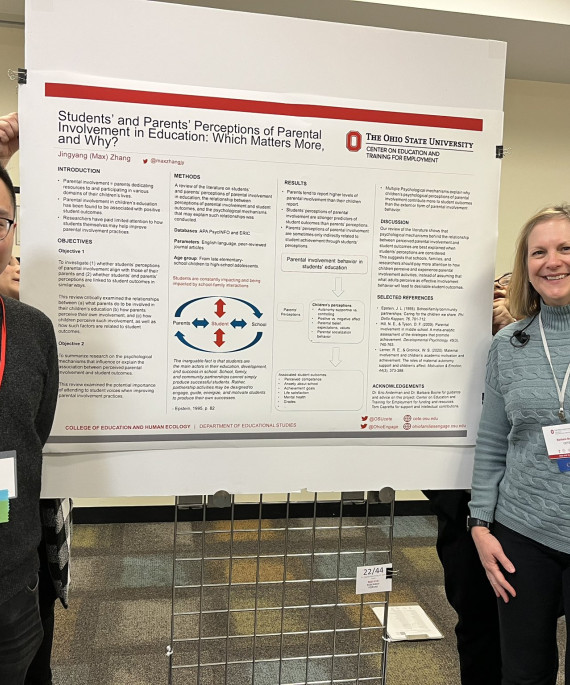
The group has been active in publishing peer-reviewed articles and practitioner pieces. It is also presenting at regional, national and international conferences and meetings, contributing to the broader body of knowledge while elevating CETE’s visibility and influence in the field.
Internally, CETE is also building its capacity as a research center committed to the responsible use of AI. It ensures that members of its community stay informed about new technologies and understand both the opportunities and limitations of AI in the workplace. CETE focuses on developing effective strategies for using these tools to enhance productivity and support sponsors’ work.
At the center of this work is CETE’s Artificial Intelligence in Education and Training program area, which serves as the driving force behind this strategic vision.
Building AI literacy and fluency in outward-facing communities
With Ohio State leading a transformative AI Fluency initiative to integrate artificial intelligence throughout students’ educational experiences, CETE is advancing this important work by extending it beyond undergraduate and graduate education into the broader workforce.
At CETE, we are promoting AI literacy in the outward-facing communities we serve by helping people understand what AI is, how it works and how to use it responsibly. This foundation can then support the development of AI fluency, or the ability to apply AI tools critically and creatively within one’s specialized field.
CETE’s Director, Ana-Paula Correia, professor of learning technologies, explains, “The projects we are advancing through CETE’s AI in Education and Training program help bridge the gap between the rapid evolution of AI technologies and the need to educate trainers, learning and development professionals and educators.
This work also positions CETE to partner directly with agencies and corporations in preparing their employees to engage with AI in responsible, ethical and effective ways.”
Preparing K–12 educators to teach and model responsible artificial intelligence use
CETE supports K–12 educators through AI-focused professional development rooted in hands‑on exploration and instructional application. AI literacy trainings help teachers across K–12 educational settings build foundational knowledge of AI and explore how these tools can enhance both instruction and day-to-day professional practice.

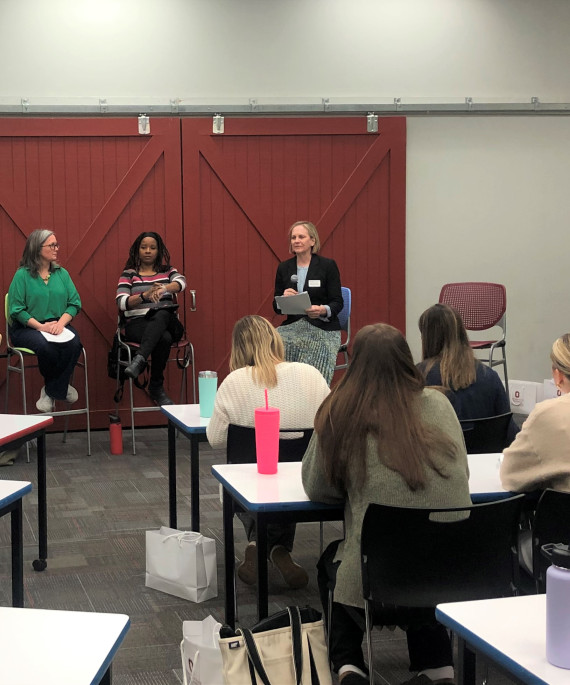
During a recent AI Literacy Training session on Jan. 15, educators at Bishop Ready High School in Columbus, Ohio, participated in an interactive workshop on foundational AI concepts, prompting strategies, generative tools and classroom implementation.
Teachers worked in small groups to explore ChatGPT, Gemini, Curipod, Magic School and image‑generation AI tools. They practiced building prompts, designing AI‑supported lessons and assessments, and developing guidance for responsible student use.
High school teachers shared their thoughts on this experience:
This was the most enjoyable, productive PD I have ever had in over 30 years. Well done!
One of the best hands-on and classroom-driven professional development sessions that I have had the opportunity to attend. I have suggested it to fellow teachers and my own daughter who is in her last year in college for early and special education.
Career-technical education professional development workshops
CETE recently launched a new professional development experience for Ohio’s career‑technical educators focused on the use of AI tools.
Through guided exploration, career-technical educators identified gaps in their own AI-related knowledge, experimented with AI tools as instructional advisors, analyzed WebXam testing data to better understand student needs and developed AI-supported instructional plans aligned with industry-specific competencies.

Growing internal capacity on responsible use of artificial intelligence
As part of its commitment to innovation and responsible technology use, CETE launched an internal initiative to help members of its community use AI safely, ethically and effectively in their daily work. The goal is not only to increase productivity, but also to build awareness of the limitations and risks of these tools, including bias, privacy concerns and misinformation.
To support organizational capacity growth, the center offers periodic one-hour virtual trainings on a variety of topics. Some of these sessions have focused specifically on building AI literacy principles and increasing AI fluency through hands-on use of tools such as ChatGPT for writing, editing, summarizing and idea generation, as well as DALL·E and Adobe Firefly for design, illustration and branding.
Contributing research, scholarship and thought leadership in artificial intelligence
CETE is committed to disseminating its evolving expertise through peer-reviewed and practitioner-focused articles on AI use in education created by the ad hoc research group in AI. The group also works diligently to elevate CETE as a thought leader and conducts research in this field.
Here are some examples of our recent scholarship:
- 4,000+ downloads of the eBook titled The Role of Artificial Intelligence in Learning and Development: Understanding ChatGPT
- 5,300+ views of the article written by Correia, Hickey and Xu titled, “Realizing the Possibilities of the Large Language Models: Strategies for Prompt Engineering in Educational Inquiries”, published in Theory Into Practice
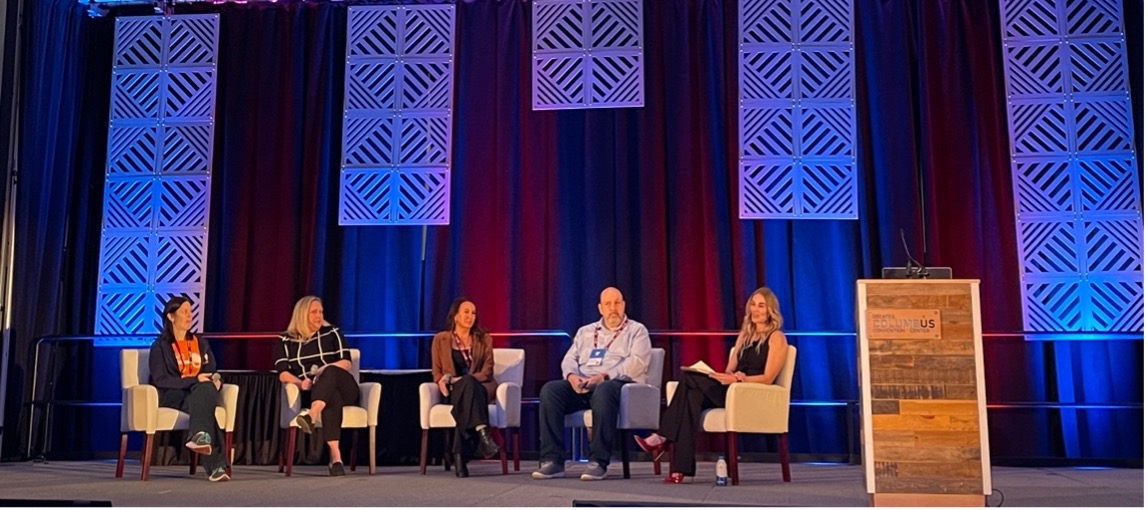
- Presentations at the Ohio Educational Technology Conference, American Educational Research Association, Society for Information Technology and Teacher Education, and Association for Educational Communications and Technology International Convention
- Invited talks at international venues such as the University of São Paulo, Brazil, and the Portuguese Catholic University
- Invited presentation to educators and administrators at the Education Service Center of Central Ohio (ESCCO) during the February Meetup on AI Fluency in K–16 Education, titled “Translating AI Research: CETE’s Approach to AI Literacy and Educator Training”
Advancing Ohio State’s land-grant mission through AI literacy and fluency
At its core, Ohio State’s land-grant mission is about expanding access to knowledge, strengthening communities and preparing people across the state to thrive in a changing world. CETE’s work in AI literacy directly supports that mission by helping families, students, educators, workers and community members develop a foundational understanding of what AI is, how it works and how to use it responsibly.
In this sense, AI literacy is not only a technical concern. It is a public good. It helps ensure that Ohioans across different settings have access to essential digital competencies, can engage thoughtfully with emerging technologies, and can participate meaningfully as AI becomes more present in education, work and everyday life.
Building on that foundation, AI fluency allows professionals to adapt, apply and innovate with AI tools in ways that strengthen their own fields of practice. Across CETE, this work is activated through initiatives such as K–12 AI workshops, family-centered learning opportunities, internal capacity-building sessions, data-informed planning with AI and specialized professional development for educators and workforce professionals.
Together, AI literacy and AI fluency reflect CETE’s commitment to translating knowledge into practice for the benefit of Ohio communities. By extending Ohio State’s leadership in responsible AI beyond the university and into outward-facing communities across the state, CETE is fulfilling the university’s land-grant mission in a future-oriented way: broadening access to knowledge, supporting local economies and cultivating informed citizens and a workforce ready to engage with AI responsibly and effectively.