

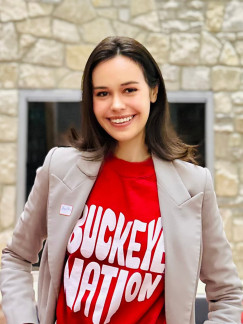
Anastasia Shikanova is a PhD student in the Learning Technologies program. She came to Ohio State to study how emerging technologies such as Generative AI can transform education.
She is also the founder and host of the "AI Fluent" GenAI Study Group, an interdisciplinary initiative within EHE for graduate students interested in exploring generative AI in education.
Read our Q and A with Anastasia to learn about her focus on helping educators use technology responsibly and effectively and the leadership opportunities she has taken on at Ohio State and at national conferences.
What is your program and year in the program?
I am a first-year PhD student in the Learning Technologies program within the Department of Educational Studies at the College of Education and Human Ecology. I am honored to be a recipient of the Distinguished University Fellowship.
What drew you to the program and Ohio State?
I was drawn to Ohio State and specifically the Learning Technologies program because of its powerful alignment between my research interests and the faculty's expertise. I came here to study how emerging technologies, especially Generative AI, can transform education by supporting learner motivation and autonomy.
The opportunity to work within EHE's innovative ecosystem and contribute to the university-wide AI Fluency Initiative made Ohio State the ideal place to bridge my background in instructional design with cutting-edge research.
The program’s commitment to both rigorous scholarship and real-world impact perfectly matches my goal of helping educators use technology responsibly and effectively.
Have you made any special connections during your program with your cohort, faculty or community?
Absolutely, and this has been one of the most rewarding aspects of my time here. Within the college, I have built strong connections with faculty who are not just advisors, but true collaborators.
I have also connected deeply with my cohort and the wider graduate student community through leadership roles, such as chair of the EHE Graduate Student Advisory Council and co-chair of the Council of Graduate Students' Academic Affairs Committee.
Beyond campus, presenting my work at conferences like AERA and OETC allows me to build a national network of scholars and practitioners who are equally passionate about the future of learning.
What are some unique experiences that you have had during your time here?
My experience has been uniquely shaped by the chance to lead and initiate projects from day one.
I founded and now host the "AI Fluent" GenAI Study Group within EHE, creating a space for students and faculty to explore AI in education together.
I have also had the privilege of presenting my research at multiple national conferences and serving as a graduate student reviewer for AERA.
Another unique experience was co-chairing and helping plan the Fifth Annual VirtuaTELL Conference. It was incredible to apply my research on AI in language learning directly to organizing a large-scale professional event.
These opportunities to instantly move from theory to leadership and practice are what make this program special.
What do you hope to achieve after graduation?
I would love to use my research and leadership skills in a role that shapes the future of educational technology. My PhD from Ohio State will be the foundation for this work.
I aim to work at the intersection of research, practice and policy, whether in an academic setting, a research organization or industry, to help design learner-centered, equitable and engaging educational environments powered by thoughtful and ethical uses of technology.
My ultimate goal is to ensure that innovations like AI truly support and empower all learners and educators.