
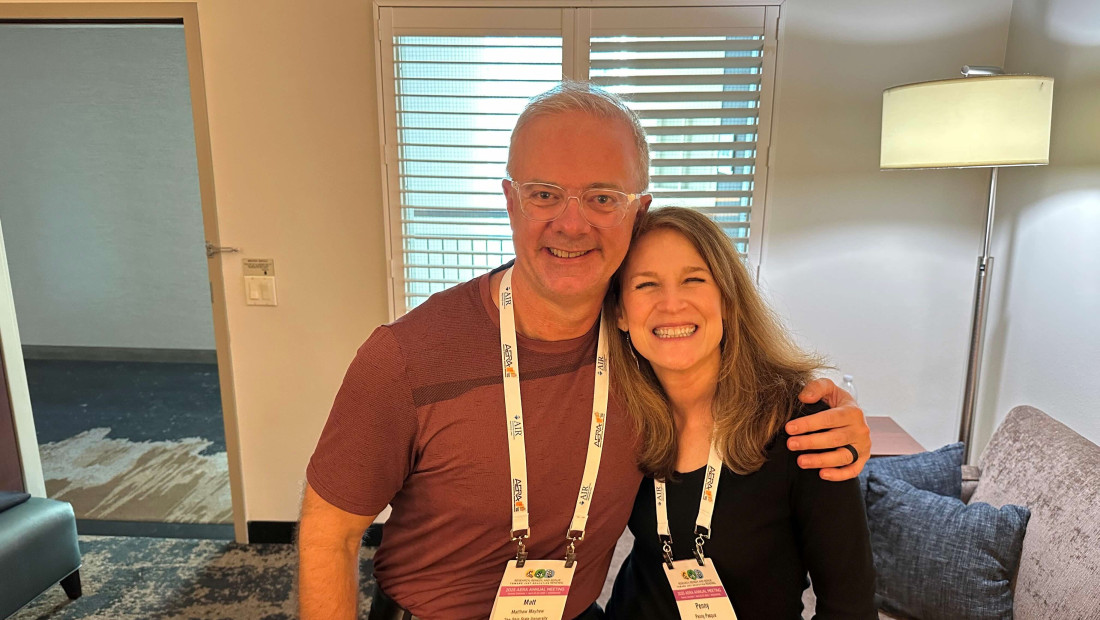
Matthew Mayhew, left, and Penny Pasque, right, both professors of higher education and student affairs, celebrate Mayhew’s induction as a Fellow at the AERA annual conference.
Faculty in higher education dedicate their careers to advancing knowledge and the impact of their discoveries. The college is proud to celebrate two members of our highly ranked Higher Education and Student Affairs program who have earned prestigious recognition for their scholarship.
This past spring, Matthew J. Mayhew, the William Ray and Marie Adamson Flesher Professor in Higher Education and Student Affairs, was inducted as a Fellow by the American Educational Research Association. The association calls its 2025 Fellows “exemplary scholars,” with a rigorous selection process requiring nomination by peers, selection by the Fellows Committee and with AERA Council approval.
The new Fellows’ “… significant contributions to the education research field demonstrate the highest standards of academic excellence and scholarship,” said the association’s Executive Director Felice J. Levine.
Professor Penny Pasque was inducted in November as an inaugural Fellow by the Association for the Study of Higher Education. In the words of Brian A. Burt, professor at the University of Wisconsin – Madison and chair of the Fellows Committee, “The new honor recognizes ASHE members who have made extraordinary contributions to higher education through scholarship, leadership and service.”
Pasque’s nominators celebrated her for advancing knowledge through research and teaching, mentoring and service to the field.
Mayhew recognized for research about college students' outcomes
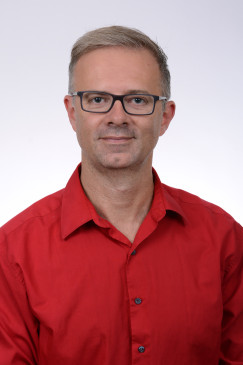
Mayhew is known for his scholarship focused on the relationship between college and its influence on student development and learning.
Laura W. Perna, vice provost for faculty at the University of Pennsylvania and one of Mayhew’s nominators, noted that his recognition reflects his extensive and influential body of research, which has significantly advanced understanding of key issues in higher education administration and exemplifies the high standards of scholarly excellence the award represents.
Perna also noted that Mayhew has “...produced major insights into how colleges and universities can create more equitable and effective environments and outcomes.” She highlighted his nationally recognized scholarship on religion and spirituality in student development.
“He has moved the field forward by challenging quantitative norms and practices that imply that the behavior of one group is normative or standard for judging others,” Perna said.
“Also noteworthy is Professor Mayhew’s record of engaging in meaningful partnerships and collaborations with other scholars at his own and other universities, as well as his commitment to disseminating the results of his scholarship to reach academics as well as college leaders, administrators and policymakers. In short, he exemplifies the ideal qualities of an AERA Fellow,” Perna said.
Scholarship about college life
An example of this nationally recognized scholarship is Mayhew’s INSPIRES Index. It captures the changing interfaith landscape of college campuses. To date, 318 colleges and universities have chosen to take part. Initial funding was provided by the Arthur Vining Davis Foundations. Now in phase four with funding from the Pew Charitable Trusts, the work will expand to recruit 75 more institutions to join the index.
In related work, Mayhew received over $2 million in funding to explore faculty religious, spiritual and secular beliefs as they relate to research, teaching and service practices. This mixed-methods study — Involving Faculty on Religious Matterings (InFORM) — is groundbreaking. It is the only initiative of its kind generating great public interest in the factors that influence faculty work.
He also was lead author of How College Affects Students: 21st Century Evidence That Higher Education Works. His peer-reviewed research has been cited more than 9,000 times so far during his academic career.
Supporting innovation in industry
Mayhew fosters innovation with industry partners through his role as co-principal investigator of several multi-million-dollar Ohio State grants. The Bridging Academic Training Through Experiential Research and Innovation project will grow the number of qualified graduates for the automotive technical workforce.
He coordinates the internal evaluation of a $1 million, three-year National Science Foundation grant, which supports university students as they develop advanced strategies to clean-tech battery manufacturing.
Mayhew’s PhD students Yun-Han Weng and Anisha Gill-Morris will execute the logistics of the evaluation plan under his guidance. They will complete rigorous coursework to enhance their expertise, which will add value to the results.
Through another industry partnership, Mayhew is the principal investigator of Enhancing Diversity in Career and Technical STEM. The multi-year study is growing diverse student representation in the automotive technical fields by increasing their recruitment, retention, graduation and workforce entry.
The project is a collaboration between Mayhew and his research team, The Ford Motor Company, the ECMC Foundation, which provided the funding, and select community colleges. The institutions all offer Ford’s Automotive Student Service Educational Training program.
Overall, Mayhew has received more than $25 million in research funding from sources such as the U.S. Department of Education and the National Science Foundation.
Pasque turns qualitative research into interdisciplinary impact

Penny Pasque, professor of higher education and student affairs, is one of the leading qualitative research experts in human sciences and education in the United States today.
Tom Nelson Laird, professor of higher education and student affairs and associate dean for Graduate Studies at Indiana University Bloomington, nominated her to become an ASHE Fellow.
“Dr. Pasque is a scholar of integrity, a mentor of exceptional generosity and a leader whose service and scholarship have strengthened ASHE and higher education more broadly,” he wrote. “She is richly deserving of recognition as an ASHE Fellow.”
One of Pasque’s nominators, Mary Ann Bodine Al-Sharif, associate professor of high education at the University of Alabama at Birmingham, said she has known Pasque for approximately 18 years.
“… in that time, I have seen the tremendous impact of her work across multiple institutions of higher education. … Her research is captivating, pushes boundaries, and helps all of us to rethink what is possible within our own qualitative research agendas.”
Bodine Al-Sharif also noted how Pasque has “paved the way to innovate qualitative research methodology … doing so while educating the next generation of researchers and practitioners to the field.”
Contributing breakthroughs to grant projects
Pasque’s leadership is evident in her interdisciplinary collaborations. As co-principal investigator of a $4.3 million grant, she leads the qualitative research component of a study focused on concussion-related vision problems among military personnel and others, ages 18-35.
As a first step in the project, she developed a Patient Report Outcome Measure to assess not only vision symptoms but also quality-of-life factors — mobility, emotional well-being, social and economic challenges — all critical to recovery.
The transformative nature of the measure creates in-depth results to assess the respondents’ experiences. The research will make a difference for military on and off the field, athletes who have concussions — for example football players on the field — and beyond.
In her research lab, Pasque includes Ruth Lu, ’22 PhD higher education and student affairs, and two graduate research associates, Mianmian Fie and Taylor Wynne.
To date, Pasque has accumulated more than $20 million in grant projects related to qualitative research. Her latest grant, with faculty in the College of Law, is about the use of AI in businesses. She has hired two graduate research associates, Matt Garcia-Ramirez and Sophia Slavin, to support the project with her.
Qualitative research support services, progress in publishing
Upon arriving at Ohio State in 2019, Pasque created the QualLab Research Center. It provides unprecedented research support services to students and fellow researchers at Ohio State and beyond.
“Through her work, this center now serves the whole of campus and engages scholars across the U.S. and abroad. It has become a “destination” resource for qualitative and mixed methods. As an example of QualLab’s reach, the first Advanced Methods Institute, which is held every two years, had over 1,600 attendees from nine countries in 2021 and again in 2023.
Pasque also advances knowledge through her 100+ publications and as editor of the Review of Higher Education. “In fact, Pasque is the first woman editor of any of the top three higher education journals since the 1970s,” wrote Noelle Arnold, associate professor of educational administration in the college and senior associate dean, in her nomination.
“At (the journal), she helped institutionalize a developmental and humanizing approach,” wrote Nelson Laird in his nomination, “supporting both authors and reviewers as well as creating a pipeline from ad-hoc reviewer to editorial board member to editorial team roles. This process not only improved journal quality, but also cultivated future scholarly leaders.
Pasque’s publications have been cited nearly 2,400 times, impressive for a mid-career scholar. This year, she edited her fourth book, Critical Qualitative Research and Social Justice: Key Concepts in Qualitative Methods from Routledge.
She has edited or co-edited nine books, including her first in 2010 as a fledgling assistant professor. Her 2023 book co-edited with PhD alum e alexander is Advancing Culturally Responsive Research and Researchers: Qualitative, Quantitative, and Mixed Methods, also from Routledge.
Arnold wrote of that book, “to my knowledge, no such text exists that provides such a comprehensive overview of culturally responsive research across fields, disciplines, and methodological approaches.”