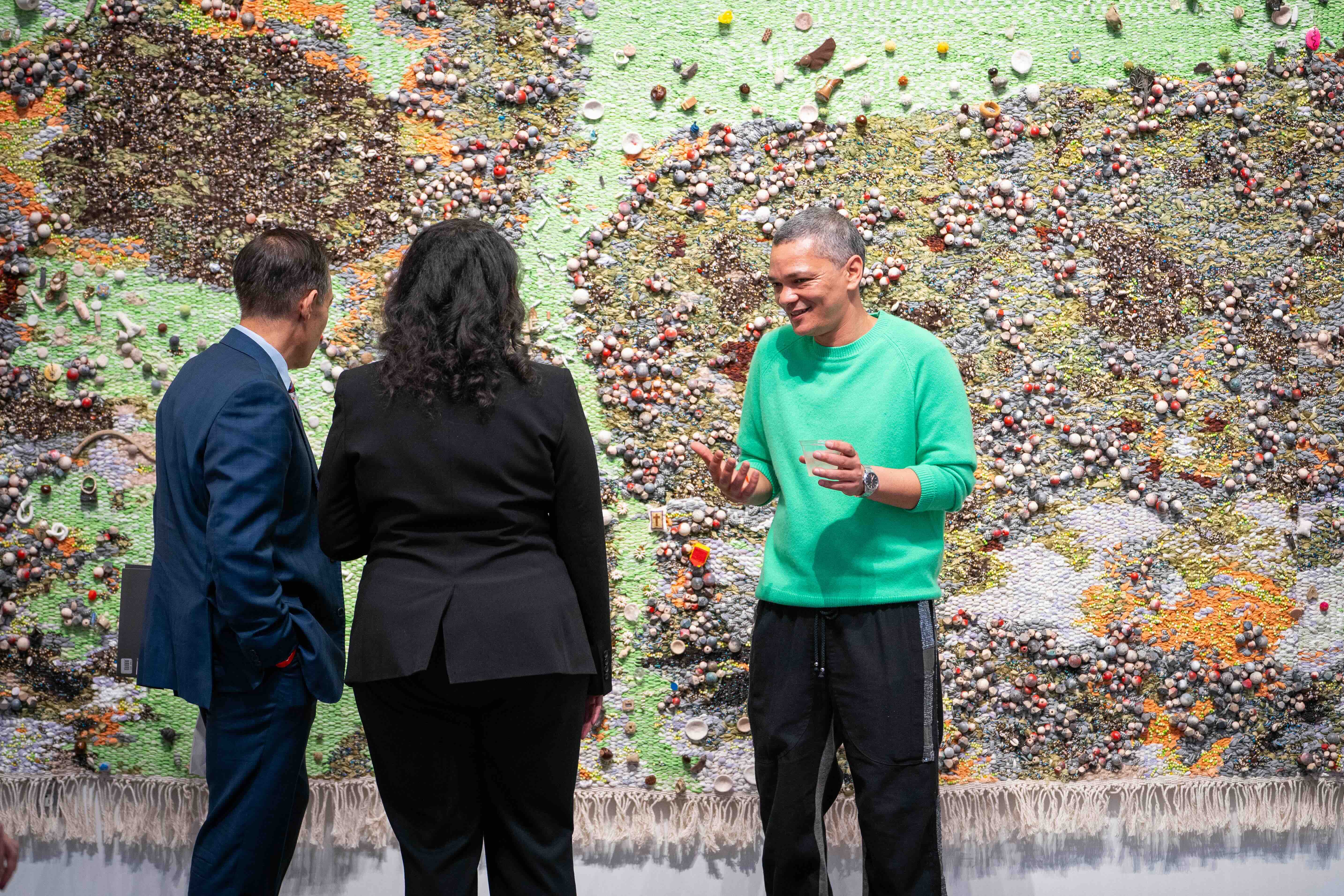
Nearly every year since childhood, internationally acclaimed artist Igshaan Adams has spent the day after Christmas at Camps Bay, an idyllic beach in Cape Town, South Africa.
“There's a certain section of the beach that was assigned to my racial group,” said Adams, who is mixed race and therefore was classified as “coloured” during the Apartheid system. “The rest of the beach was for white people, or ‘first-class citizens.’ Where there were third-class (Black citizens), they weren't allowed on the beach unless they were cleaners or gardeners.”
Five years before the fall of Apartheid in 1994, social pressures forced the desegregation of most South African beaches. Still, each December 26 since then, a peculiar thing happens.
“If I will go this year to the beach with my family, everybody is going to go to that side of the beach that they were (once) assigned. This boggles my mind. This bothers me.”
Yet Adams finds evidence of hope and disruptive change in the landscape surrounding the townships where he grew up. He fashions his art after the hard-packed dirt paths, etched into the terrain when people choose to go off the “established” path.
His 500-square-foot tapestry, All the Hands, is a depiction of these paths. It was dedicated Oct. 28 in Ohio State’s Campbell Hall as part of the State of Ohio’s Percent for Art program.
About the art
The vibrant tapestry contains multiple, diverse fibers that become a highly stylized map that weaves a story spanning space and time, creating ties between people living generations and oceans apart. Its narrative is one of yearning and resistance, of people like Adams, living out hope and leaving their mark, simply by putting one foot in front of the other.
-
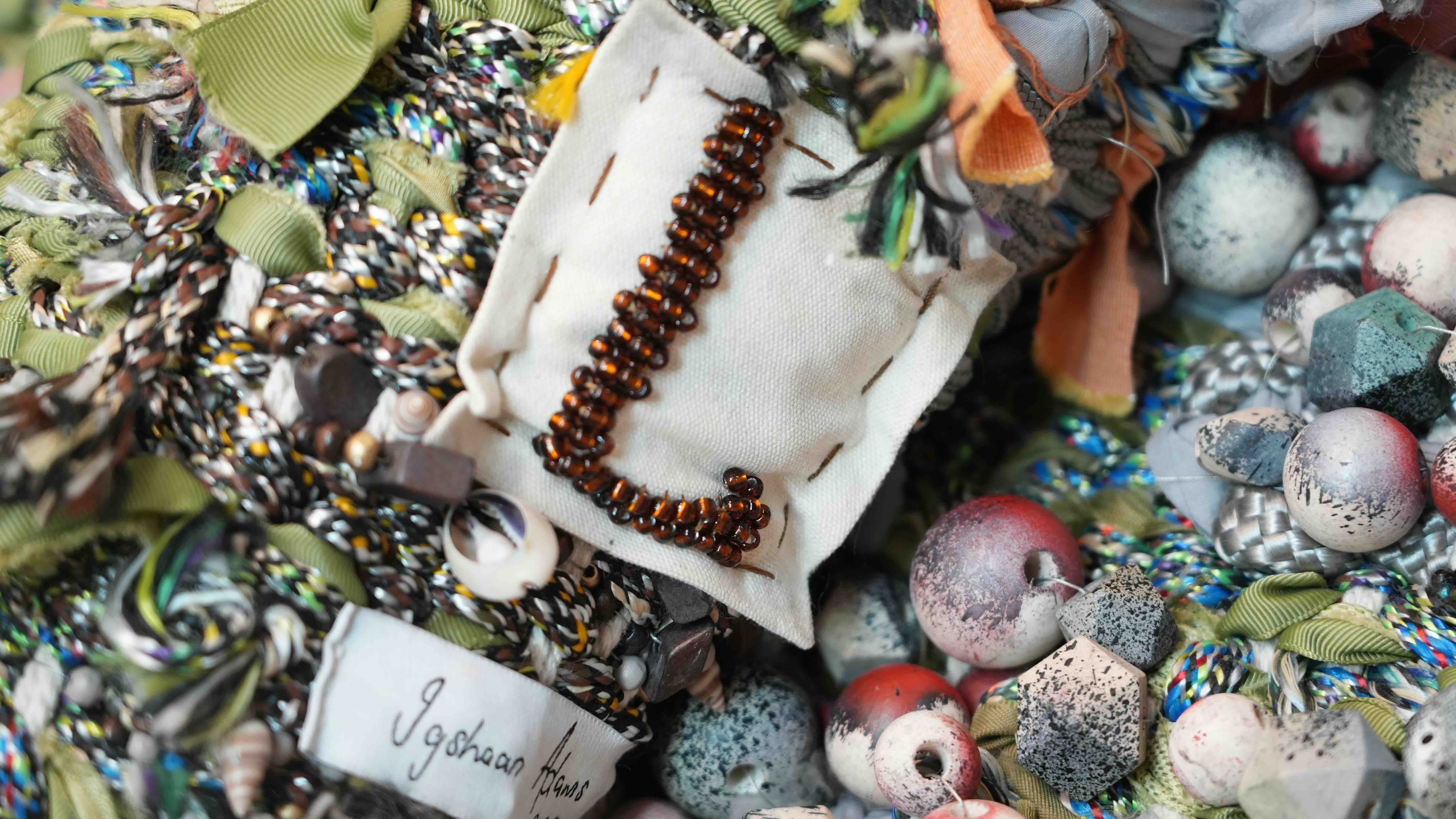 A beaded art detail stitched to All the Hands by Igshaan Adams. Miniature art works were created by artisans in South Africa and art students in Columbus.
-
 Rolled paper beads were created by fifth graders at Metro Middle School.
-
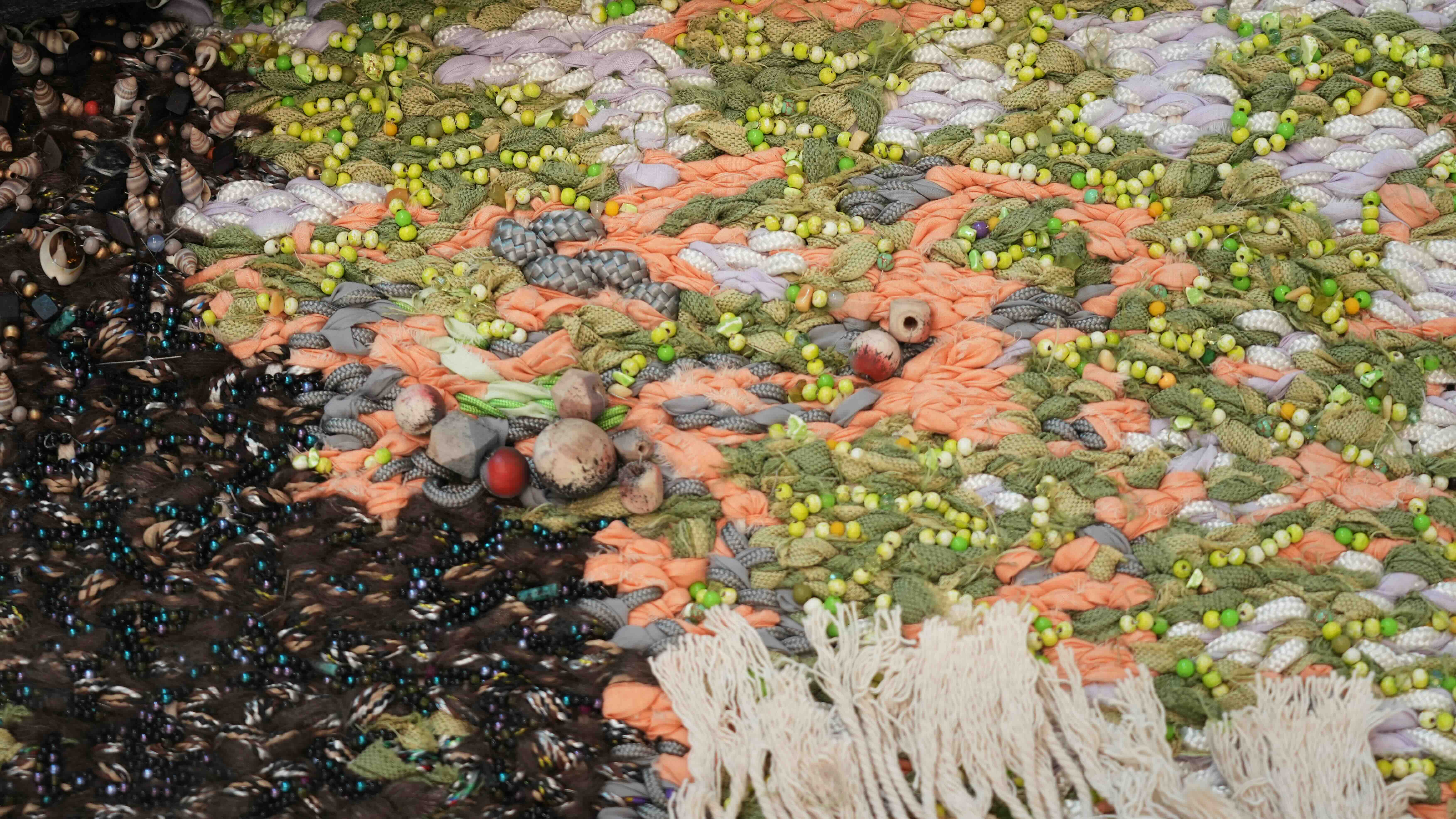 Strings of beads were assembled by neighbors in Cape Town neighborhoods, then woven into the art.
-
 Wire sculptures near the tapestry represent clouds, which Adams conceptualized as capturing dreams of people walking desire paths.
-
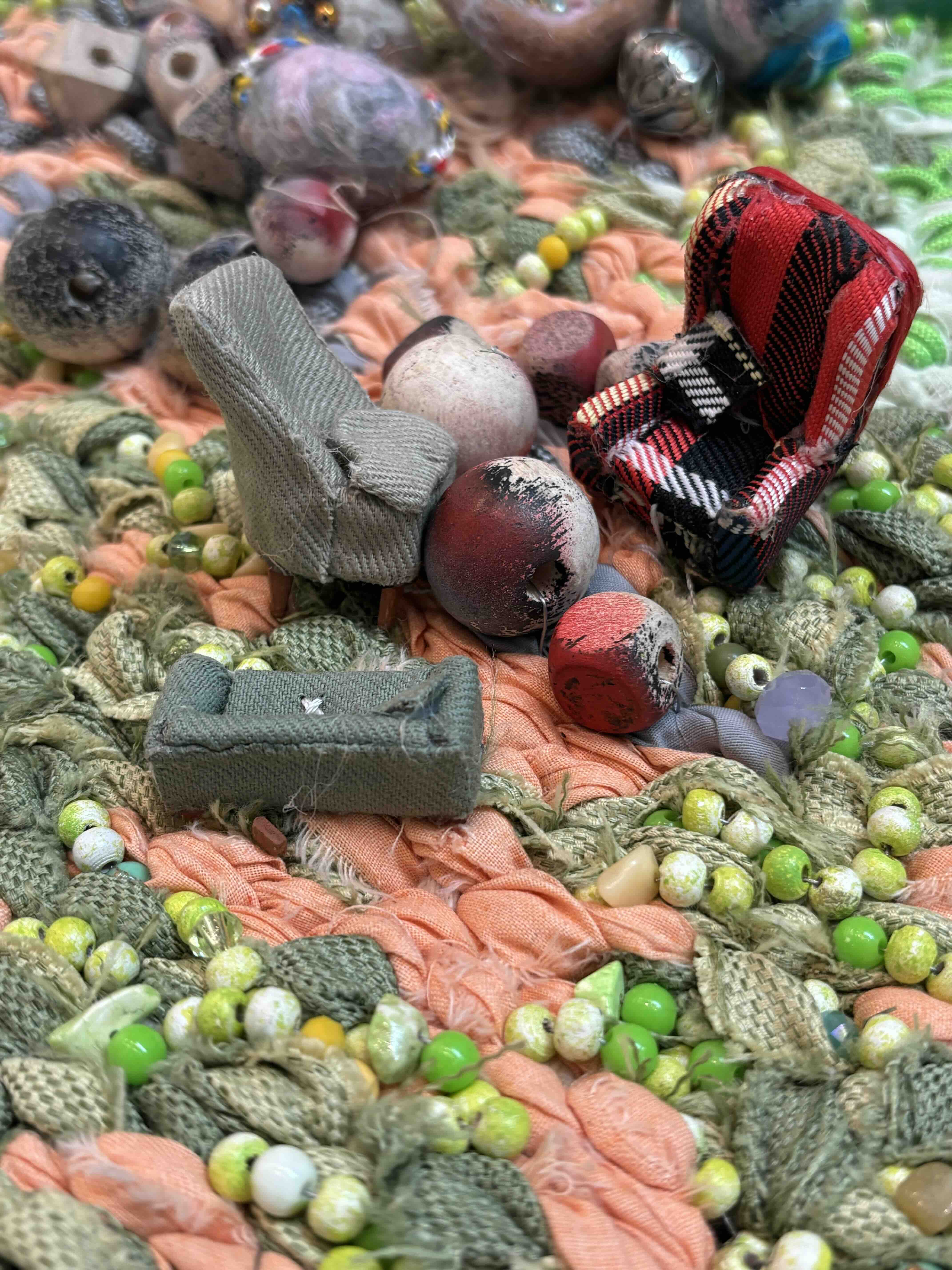 Tiny furniture was crafted by artisans in South Africa.
Up close, the art can be viewed as a microcosm: fibers woven and knotted with hundreds of tiny artifacts — shells, clay objects, bits of shaped metal, wood and felt. Viewing from the distance of a few inches is like discovering the complexity of an ant colony at your feet.
But back off 20 feet or more and an expanded truth comes into focus. The objects become markers — people, their footsteps or what Adams calls ‘vessels’ holding dreams — of a much broader reality.
“I've always had the feeling that the external world influences quite a bit of what happens internally — the qualities within that world, whether it's beautiful or whether it's neglected — filters inward,” Adams said.
“I was curious about the qualities of the world that my identity was formed in, and how it had influenced how I see the world, how I react to the world. This is maybe still part of that inquiry of filling out environments in where these connections are formed.”
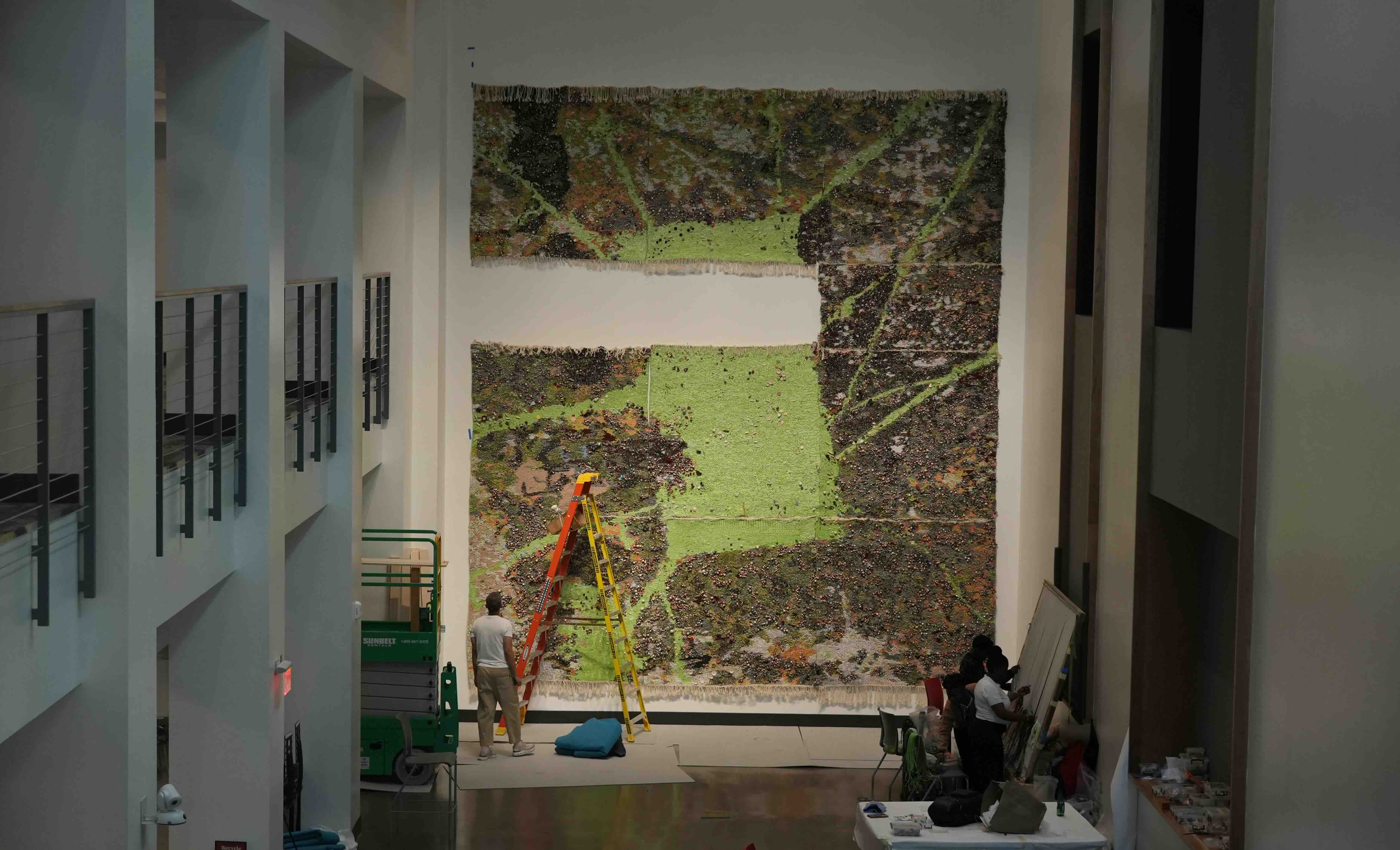
The pathways, of course, speak of a desire to find one's own way.
“Someone has laid out a space, saying this is how people should use it,” he said. “‘This is the sidewalk, and this is how a car should use it.’ And human beings eventually come and carve out their own path that makes more sense to them.”
In Bonteheuwel, the community where Adams grew up, the routes are small acts of resistance. But they also mark desires because the people walking them desperately hope the passages lead to opportunity.
Desire lines, even on the Oval
The idea translates to almost any community. Consider the sidewalks of Ohio State’s Oval, and a similar randomness emerges. The off-kilter pattern of sidewalks wasn’t what chief architect Joseph Bradford had in mind in 1914, when he planned the university’s signature campus space. His design called for a formal, geometric pattern of overlapping diamond shapes.
However, the surrounding architecture was expensive and funds ran short. So, for years, students cut their own paths “at places of convenience,” one architecture professor wrote. A Lantern writer joked that students disappeared into the mud. These, too, were desire lines.
When funds became available, the students’ paths, not the original design, were paved.
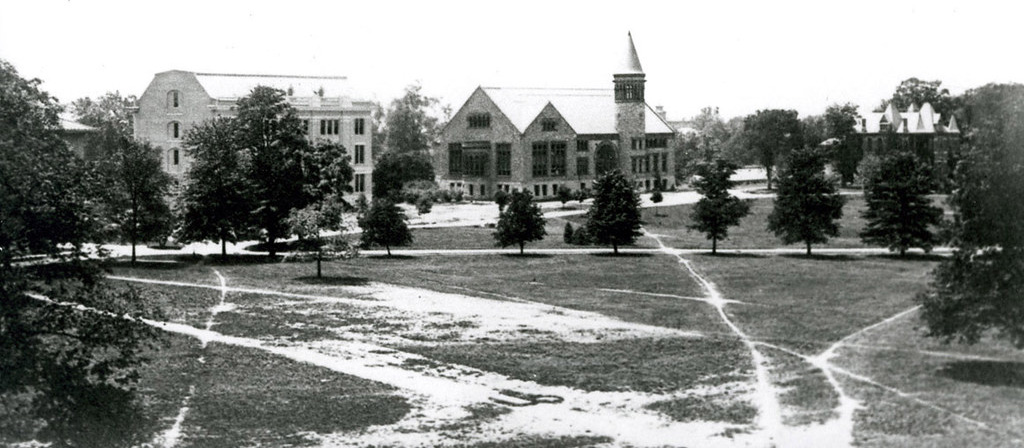
Ohio State’s campus doesn’t share South Africa’s history. But students still walk the Oval yearning for a better life to come. And some still go off path.
“On the Oval, and on paths in Cape Town, people convene at the intersections,” Erik Porfeli, interim dean of the College of Education and Human Ecology, said at the art dedication.
Indeed, like the Oval, the open green space in All the Hands depicts a tar pitch where some in Cape Town converge to play sports or converse.
“This tapestry is a beautiful reminder that we are on individual journeys that become collective journeys. Like the beads and vessels represented here, we leave our mark, then make our way along the trail to the place where our dreams take us.”
Veering off to the unexpected
Adams and his assistants explored the Oval before designing All the Hands. Desire lines, Adams pointed out, are universal. His family members were forced into careers where ceilings were artificially imposed because of their race.
“There was a whole set of guidelines for you as a second-class citizen in terms of where you can ultimately end up, or the height that you can reach in terms of your career or development,” Adams said.
“There was no art in my life. There was no artist. This was a completely foreign world to any of us, and so I had to find my own way, just like when people find a path or create a path that makes more sense for them,” he said.
He desperately wanted to study, so as a young man, he saved just enough to apply to college. His aunt and grandmother helped him pay tuition for his first semester to study art and design at the College of Cape Town. After he received his certificate, he began working as a gardener.
“I really didn't believe I was good enough,” he said at an art talk with Jared Thorne, Ohio State associate professor of art.
Two near-death experiences settled for him that he must pursue his dream. He attended Ruth Prowse School of Art in Cape Town and began creating pieces using fabric because he couldn’t afford paint. His family allowed him to cut the upholstery off the back of their furniture.
“The house was very small … and they would stack up with the furniture outside and allow me to use the living room as a studio,” Adams said. “And everybody else had to find (another) way into the house.”
Success for a community
He since was named Standard Bank Young Artist of the Year in South Africa and has had solo exhibitions in Oslo, London, New York, Chicago, Zurich and Rotterdam to name a few. His work has appeared in the Guggenheim in Bilbao, Spain, and is among the permanent collections at the Art Institute of Chicago, the Stedelijk Museum in Amsterdam and others.
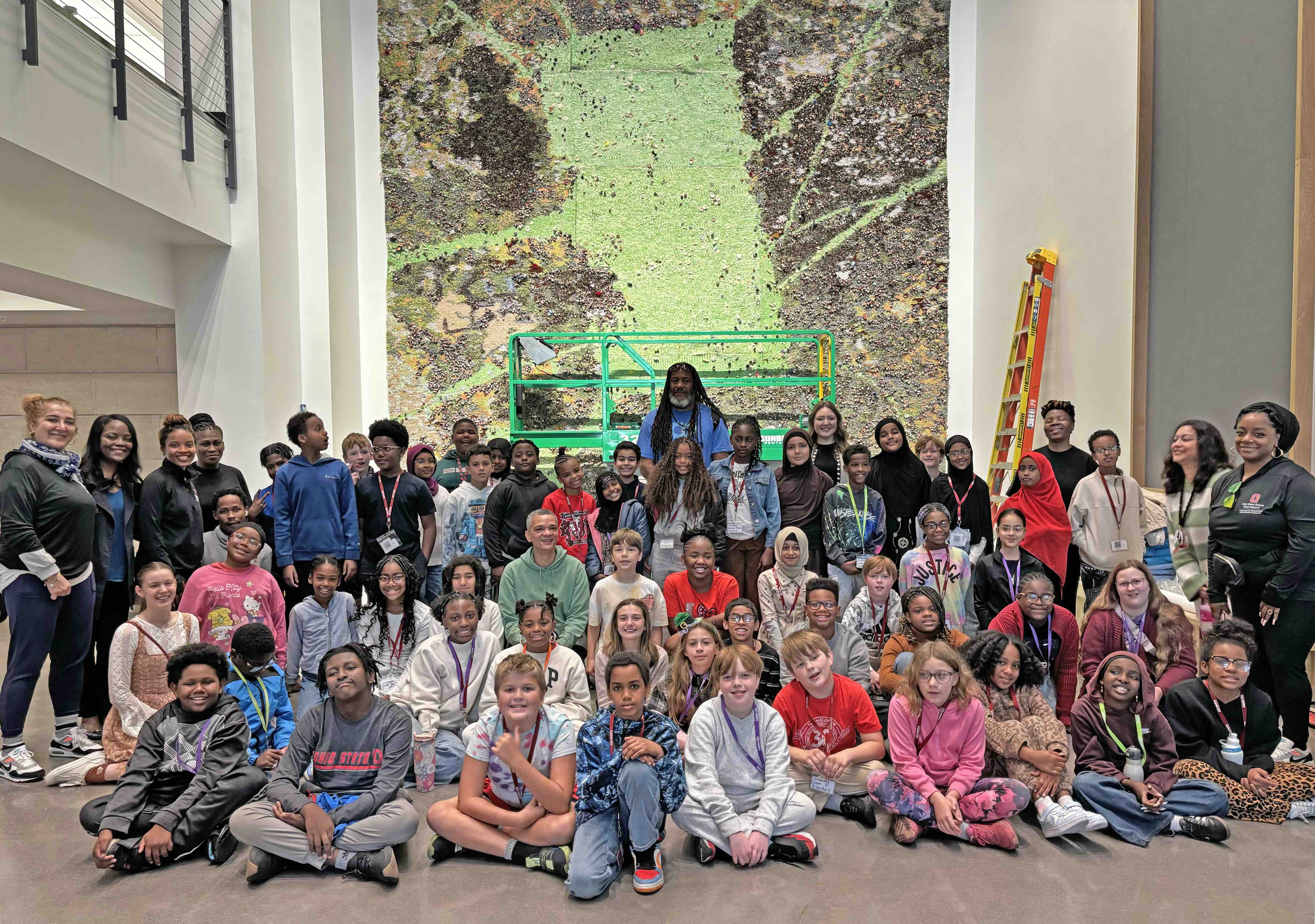
The artist travels extensively for his shows and collects beads and small art items wherever he goes, he told a group of Metro Middle School fifth graders. (Their painted and rolled paper beads are incorporated into All the Hands, along with clay vessels made by Afrocentric High School art students.)
A doll from Uzbekistan is stitched onto the Campbell Hall tapestry. The young boy selling it on the Uzbek street at first dropped the doll and ran in fear, because he had never seen Black people. His father convinced him to return and talk to Adams and his assistants.
“It was a beautiful moment of coming together,” Adams said.
Adams’ life circumstances and introspection through art have made him extraordinarily compassionate. His international success does not eclipse his connection to his roots. He employs 25 assistants, including some family, to weave and help him sew his designs and manage his studio. He commissions artisans throughout South Africa to make many of the beads and fibers in the art.
He also distributes bags of beads to neighbors who struggle to find work, asking them to string them so that he and his assistants can weave them into the tapestries.
“We of course pay each family or program,” he told the fifth graders, who were eager to find their own miniature works of art among the massive piece, too.
In this way, the tapestry in Campbell Hall truly lives up to its name. All the Hands, indeed.
-
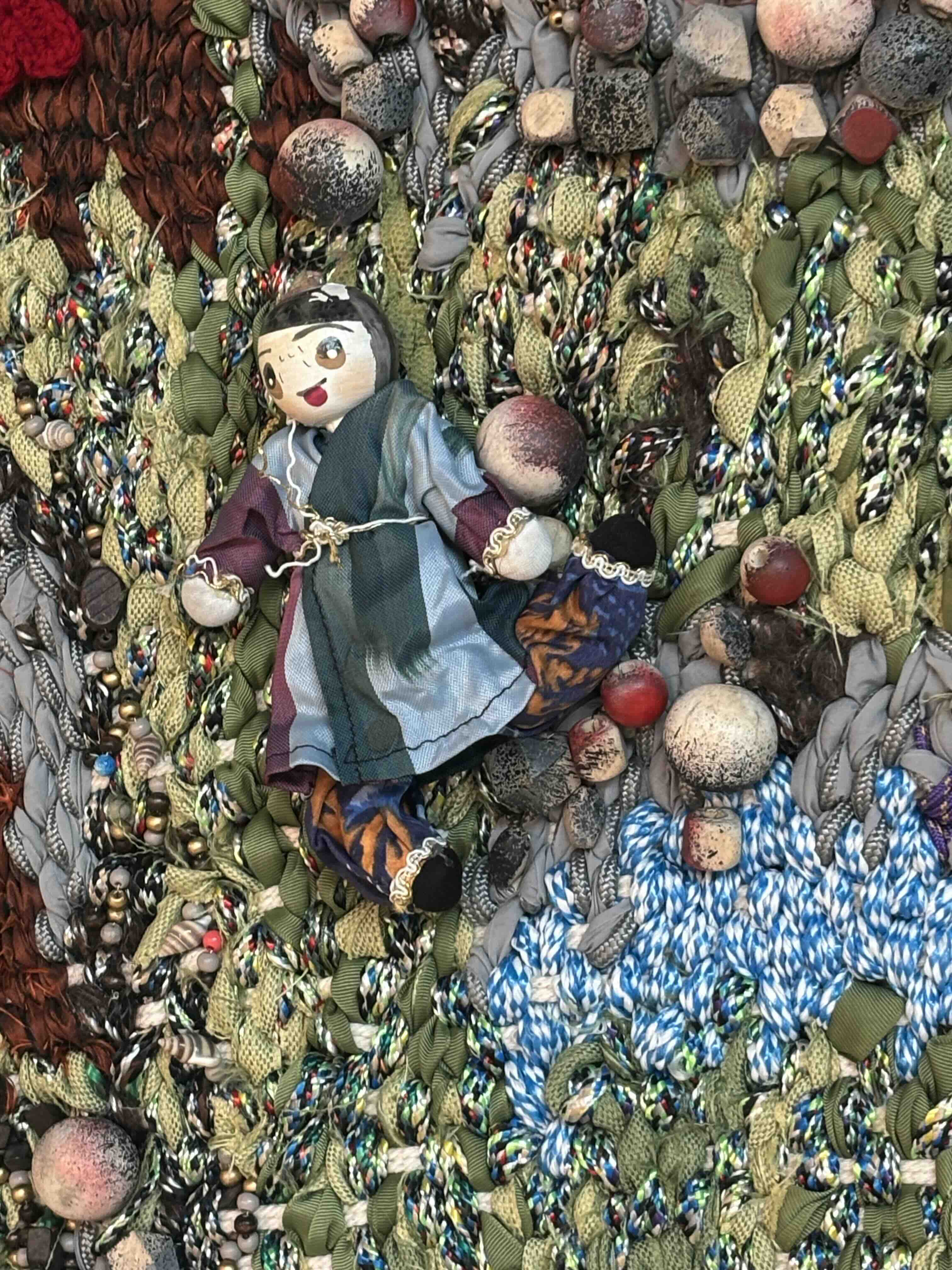 A doll purchased from a young boy in Uzbekistan is part of the tapestry.
 Adams stitches items to the tapestry. Some work was done in Campbell Hall so that people could see the process.
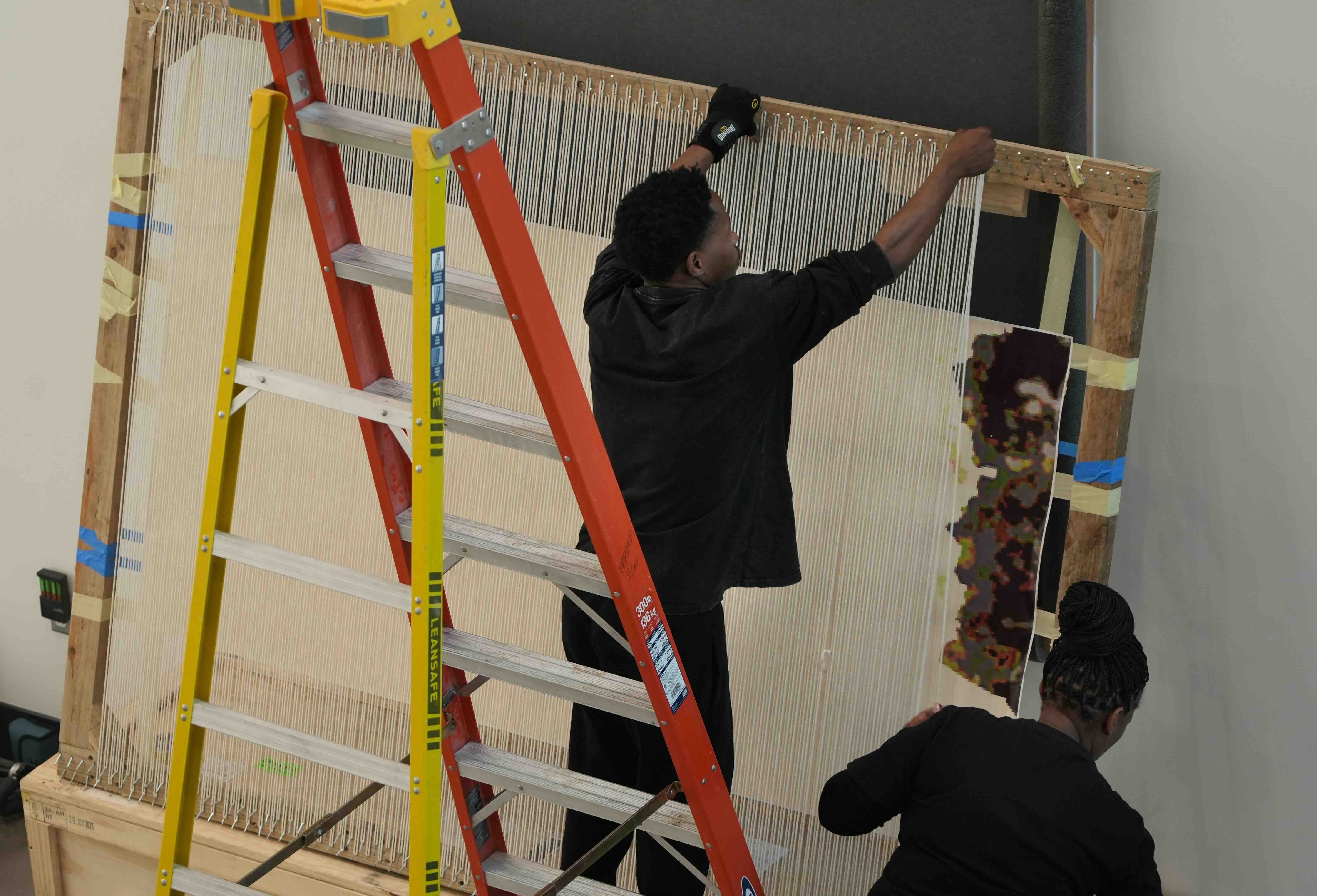 Lindokuhle Mzila sets up a loom in Campbell Hall to weave a portion of All the Hands.
-
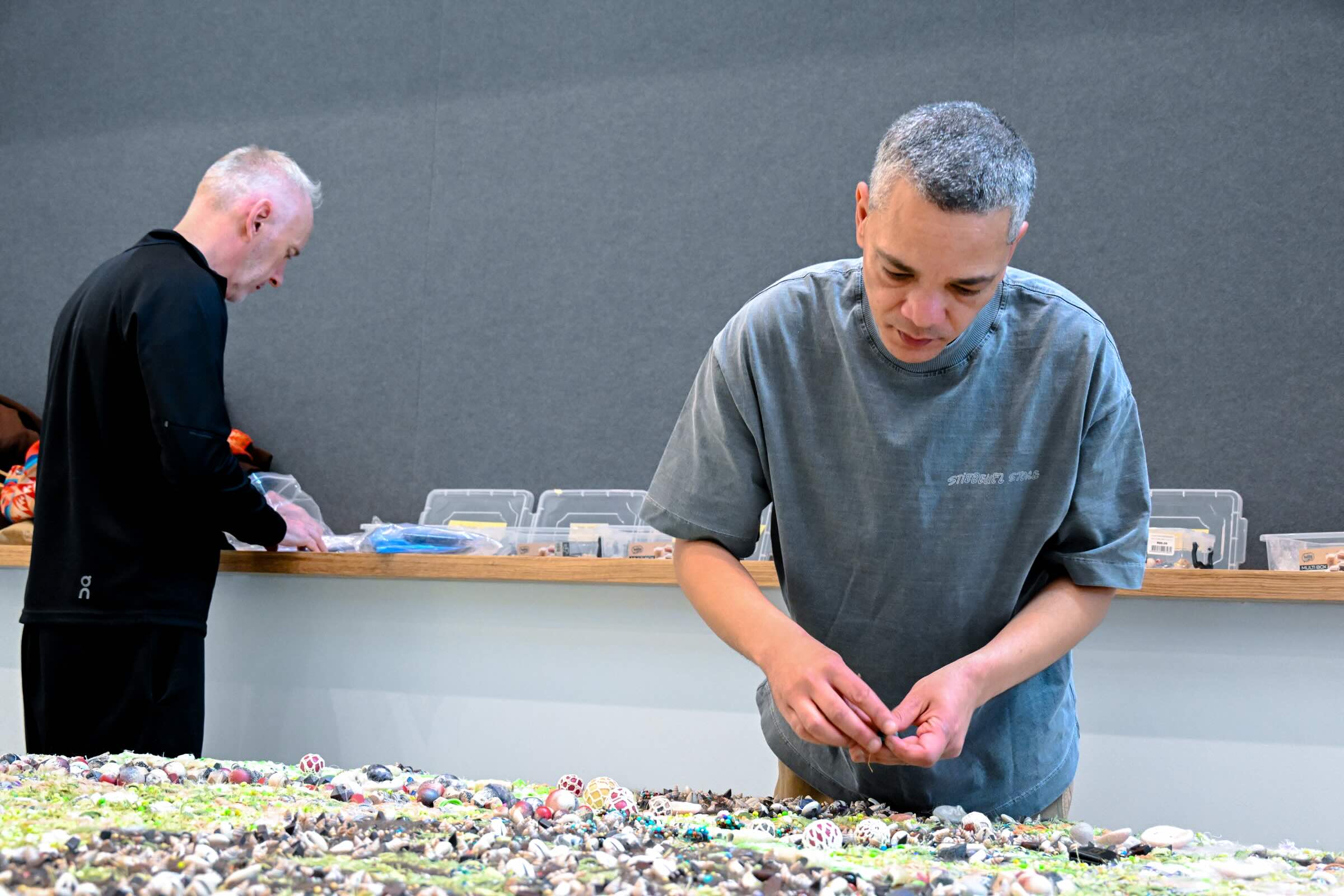 Tony Webster, left, and Igshaan Adams sort beads and other art pieces.
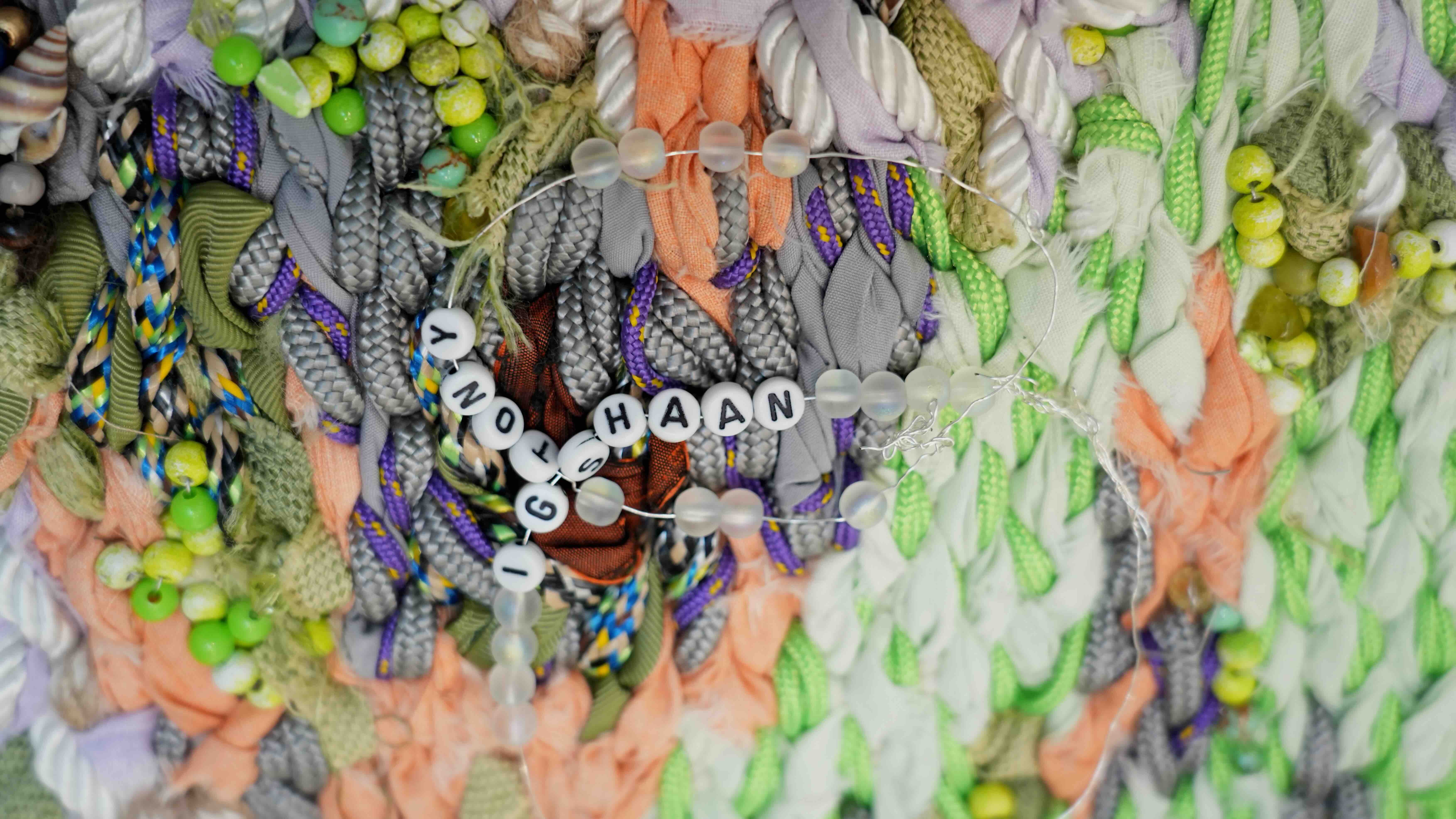 Beads spelling the names of Adams and his partner were strung by the daughter of a fellow artist.
 One of Adams’ assistants weaves fibers for a tapestry panel.
-
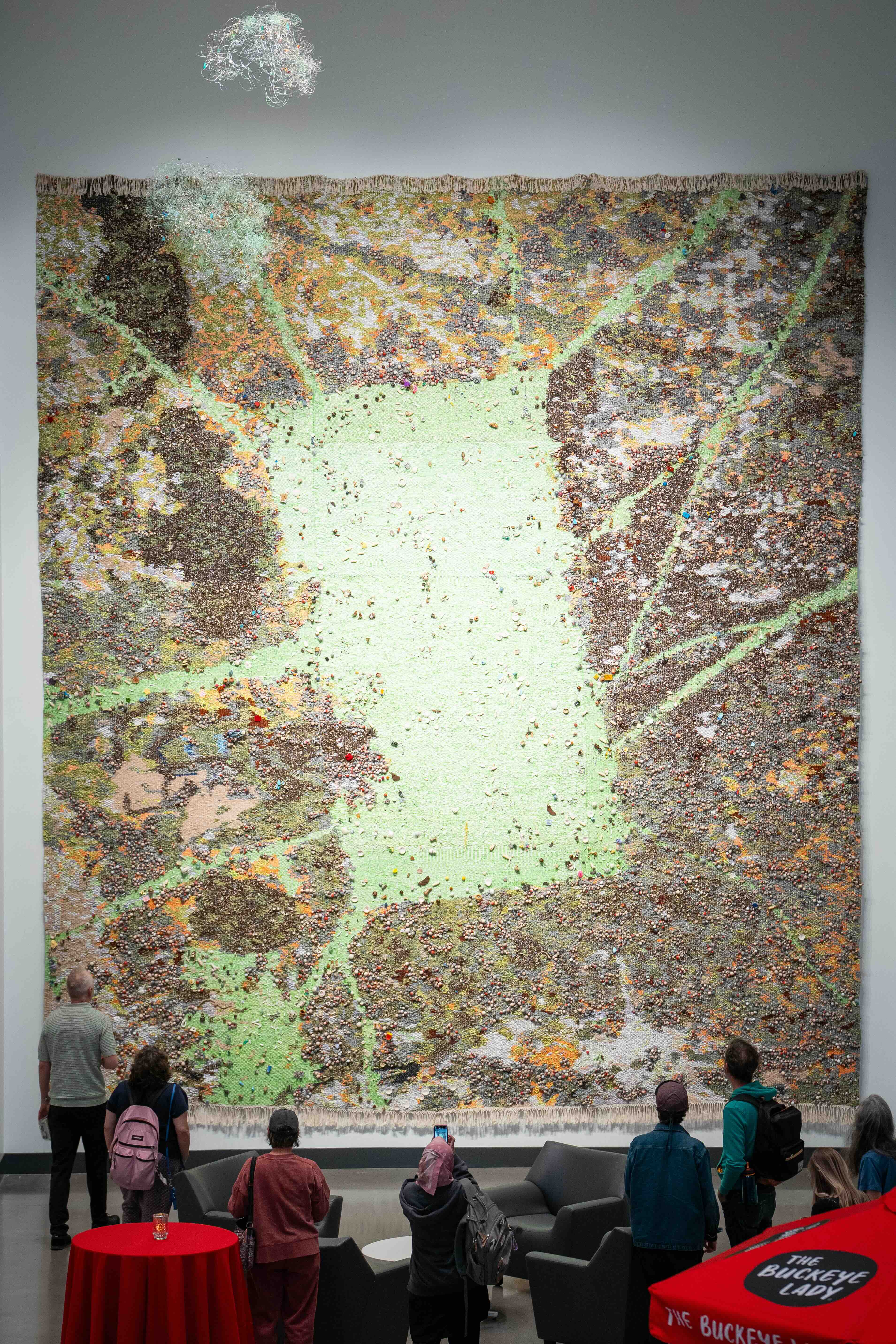 All the Hands depicts a real South African landscape marked by “desire lines,” cut when people go off path. The Oval paths were formed the same way.
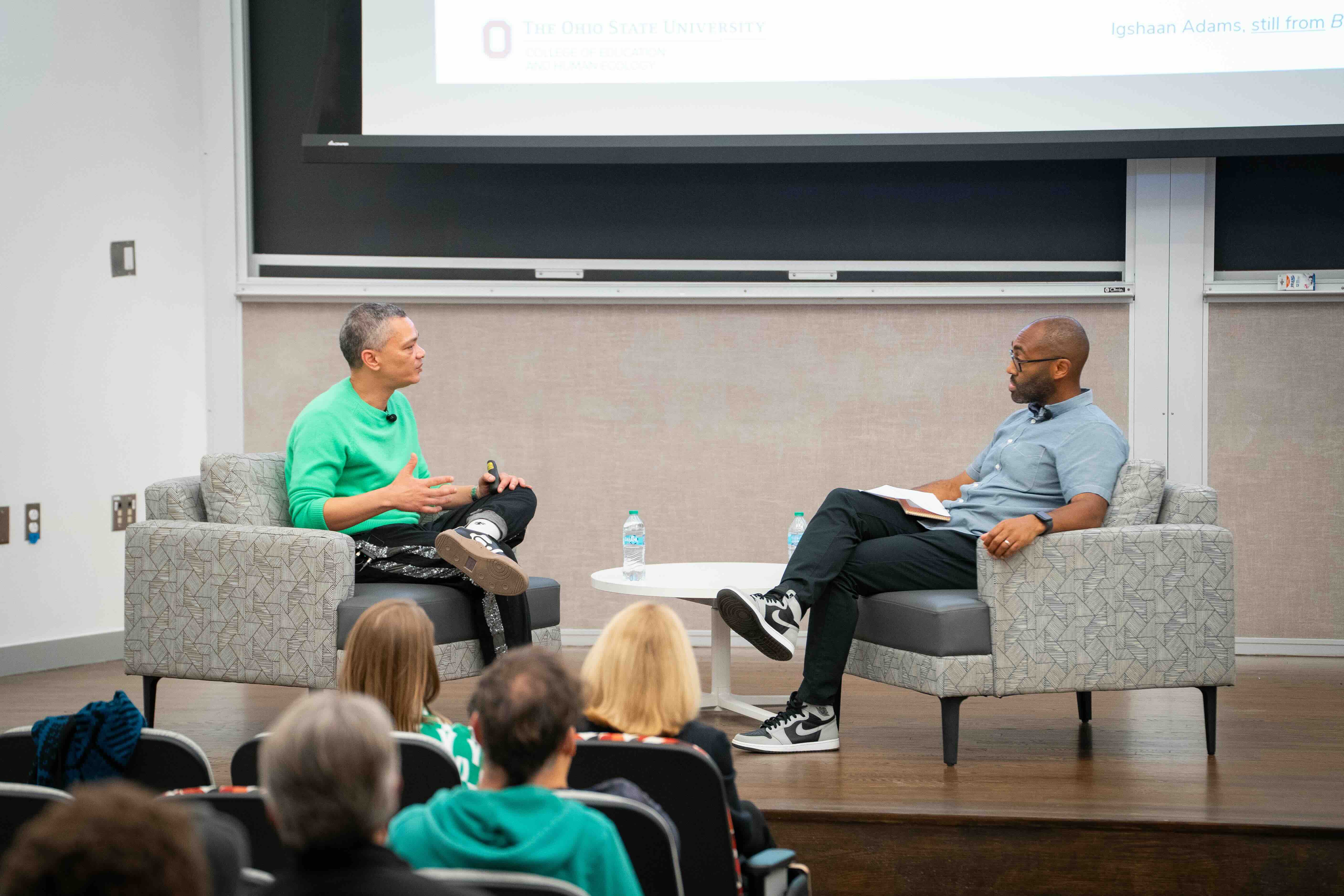 Igshaan Adams and Jared Thorne, associate professor of art, discuss Adams’ work at an artist’s talk Oct. 28.