
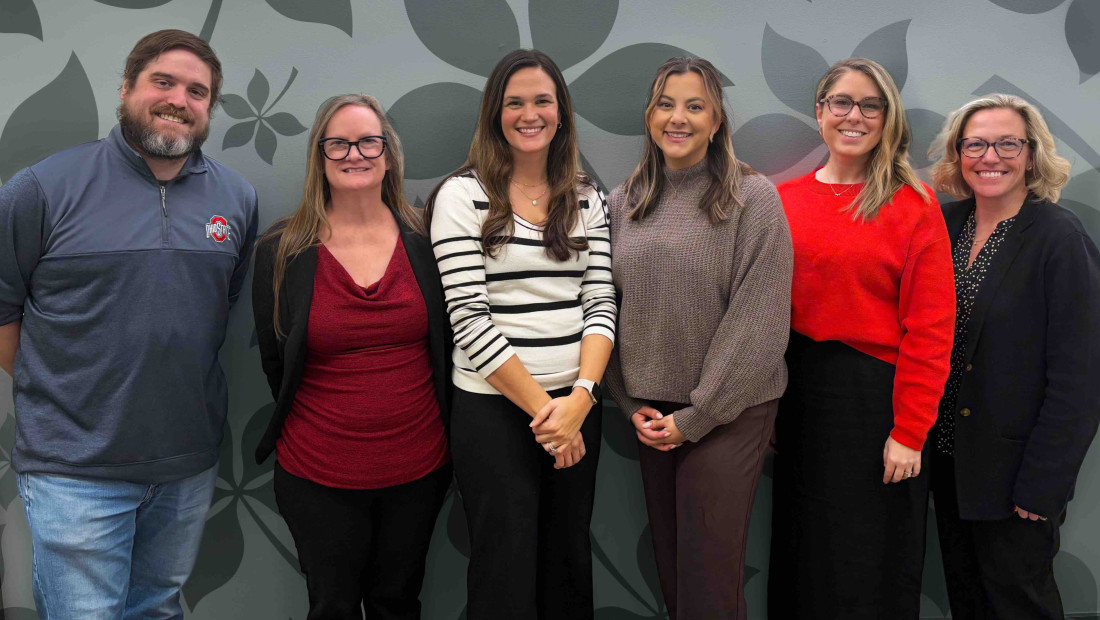
Team members: Tony Smith, Robyn Yates, Kathleen Lynch, Megan Schertel, Lauren Salamone, Christine Fagan
The Office of Accreditation, Placement and Licensure (APL) supports all Ohio State educator preparation programs that lead to PK–12 licensure in teaching, administration and pupil services. As the college’s central hub for educator preparation data, APL manages data collection, analysis, accreditation reporting and compliance, as well as field placements and licensure.
The team collaborates with colleagues across the college, with program representatives on regional campuses and in other colleges. It partners in PK-12 districts and agencies and supports contracted courses for in-service teachers, as well as oversees the administration of the Candidate Preservice Assessment for Student Teaching with over 150 partner institutions.
Q: How does the college and its students benefit from the work your team does?
A: Our work ensures that the university’s educator preparation programs meet state, national and professional standards. That means our students graduate fully prepared — and fully eligible — to become licensed PK-12 educators and professionals. Behind the scenes, we gather data, monitor compliance, coordinate placements and support programs through the accreditation cycle.
The benefit to students is simple: When we do our job well, they experience a seamless path from coursework to fieldwork, to licensure, to employment. Our work enhances their preparation and helps strengthen the partnerships the college has with schools and communities across the state.
Q: Are you all “numbers” people (analytical or process oriented)? How does that aid your work?
A: Being analytical and process oriented is essential to what we do even though all of our roles don’t require “number crunching” every day. APL handles large volumes of data, reporting, inquiries and documentation, and accuracy matters.
Our “numbers brain” helps us catch trends early, tell a clear story about program performance, and it helps us anticipate what adjustments are needed next. We’re always refining processes, building better systems and looking for ways to efficiently support programs.
That combination of data awareness and process discipline helps the entire college operate smoothly.
Q: Do you have a running office joke? If you don’t, what could that be?
A: If we were to adopt an office motto, it might be: In this office, a well-timed GIF is a communication strategy.
Q: What’s the coolest or most unexpected thing APL data has revealed?
A: One of the coolest things APL data reveals is how interconnected everything is — a small curriculum change, a new placement partner or a shift in assessment design can show up later in licensure pass rates, employment outcomes or program strengths.
It’s also fascinating when data confirms something we’ve suspected intuitively. Seeing numbers illuminate the impact our graduates have in Ohio schools — especially in high-need areas — is always a powerful reminder of why our work matters.
Q. What’s the most difficult part of the work your office does? What’s the most rewarding?
A: The most difficult: Accreditation and licensure requirements are always evolving, which means we constantly translate complex policy changes into clear, actionable steps for programs. Balancing those demands with high volume and tight timelines can be challenging.
The most rewarding: Seeing the direct impact on students. When a graduate earns their license, secures a job and begins their professional journey, we know the systems we manage helped make that possible.
It’s also incredibly rewarding to support academic units and see how our the behind-the-scenes work strengthens the quality of the university’s programs. We value working with so many dedicated professionals across EHE.