
Reading and Writing Research into Practice
Responding to both new state policy and the pressing needs of Ohio’s schools, the Reading and Writing Research into Practice initiative positions Ohio State and the College of Education and Human Ecology as a nationally recognized leader in the science of reading and writing.
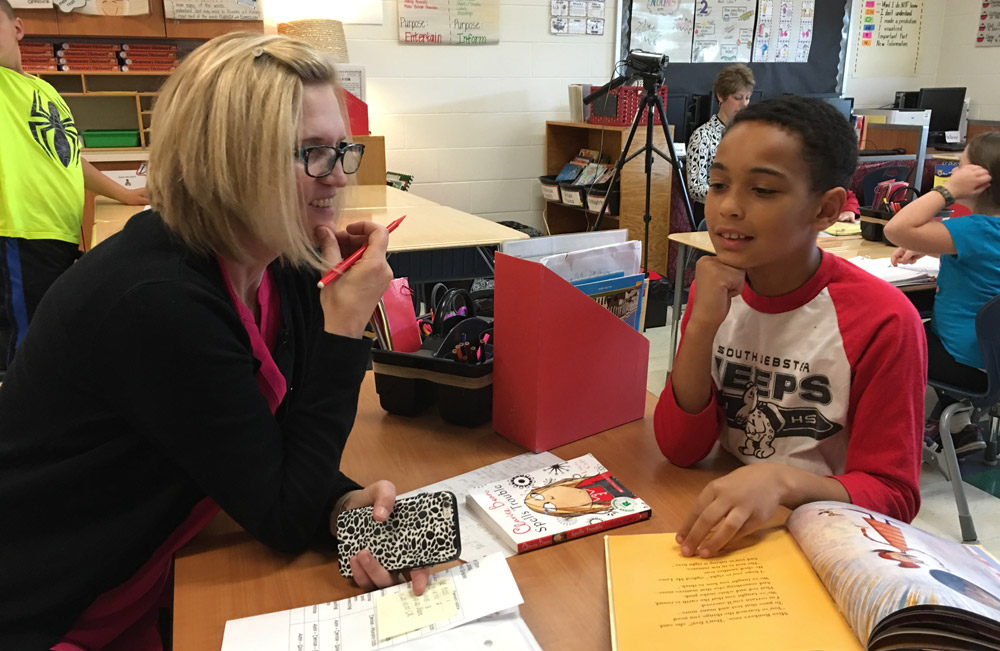
A focus on science of teaching reading research
At its core, the initiative aims to achieve excellence in research and practice related to science of reading and writing. Particular focus is on the science of teaching reading. The initiative emphasizes research and practice within teacher education, specifically translating that research into:
- Teacher preparation and professional learning across the educator workforce
- Evidence-informed instructional practices
- Using data from teachers and school districts to respond to the needs of P-12 schools and other education partners
What is the science of teaching reading?
The science of teaching reading emphasizes evidence-informed teaching practices and their implementation, preservice teacher preparation, in-service professional learning and coaching, and bi-directional research into practice translation.
This initiative is unique to institutions of higher education in Ohio, with its dual emphases on research and practice; inclusion of writing alongside reading (a recent expansion of SOR; Graham, 2020; Piasta, 2026); attention to supporting university students at all levels and commitment to translational science.
By foregrounding the science of teaching reading (SOTR), this initiative:
- Addresses a widely acknowledged gap in the field — of research and practice for teaching reading — as well as a gap in the current offerings from Ohio institutions of higher education
- Aligns with Ohio State research-intensive and land-grant statuses
- Advances the missions of Ohio State, the college and the Department of Teaching and Learning
- Aligns with Ohio State’s AI fluency initiative by preparing future educators to understand how to leverage and ethically apply artificial intelligence in literacy teaching and learning
- Can help to increase Ohio State pass rates on the Ohio Assessments for Educators Foundations of Reading exam
Building on nationally recognized expertise
Connections to other college programs ensure that the initiative is grounded in research, responsive to the needs of all learners and aligned across the P-8 grade span. At the same time, it maintains a clear anchor in teacher preparation, research and professional learning. Other relevant areas of expertise include:
- Early childhood education
- High-quality, culturally relevant children’s literature
- Language development and pedagogy
- Literacy and learning differences
- Workforce development and professional learning across the college’s relevant centers and programs, including:
- Crane Center for Early Childhood Research and Policy
- Center on Education and Training for Employment
- International Data Center for Evaluation
- Special Education program
- School and Educational Psychology programs
- Human Development and Family Science program
- Multilingual Education program
Goals for Reading and Writing Research into Practice
- Expand capacity for conducting, communicating and employing reading and writing research to enhance teacher education and PK-8 reading and writing instruction
- Enhance teacher preparation across the continuum from pre-service undergraduate education to professional learning of practicing educators
- Enhance partnerships between P-12 schools and the university, making statewide impact on reading and writing.
- Cultivate accurate, nuanced understandings and applications of SOR/SOTR, across the state and nation, as a body of knowledge derived from various research disciplines that includes multiple essential components (e.g., oral language and vocabulary, phonological awareness, phonics knowledge, fluency, comprehension, writing, motivation and engagement).
- Achieve the college’s outreach and engagement mission and its established infrastructure for working with P-12 schools and strengthening school-university partnerships
Duration
The initial start-up phase: 3.5 years, from January 2026 - July 2028
Building and sustainability phase: August 2028 - forward
Research collaboration between faculty and community
The college will hire faculty with expertise who are committed to school and community engagement/research into practice translation and have high potential for securing external grants and contracts for research.
These new faculty will supervise and instruct teacher education literacy courses, teach pre-service and in-service teachers within the Department of teaching and Learning, engage with local school districts to enhance professional learning, and collaborate with colleagues across the college on initiative activities.
The initiative incentivizes conducting and disseminating research on SOTR. This research can be initiated by faculty and by Ohio districts, schools, state-level partners and educational organizations.
Grants and funding
The Ohio State University will fund about $1 million to the Reading and Writing Research to Practice initiative. The college will contribute $1.2 million in funding.
Small grants will be available to faculty to conduct initiative-relevant research on evidence-informed reading and writing teaching practices, teacher preparation, in-service professional learning and research into practice translation.
The grants may fund limited-scope studies and/or pilot studies needed to pursue extramural funding. Or they may stem from problems of practice posed by Ohio districts/schools/organizations. We will also fund research evaluating the initiative (e.g., new coursework, programs).
Faculty, staff and students will have access to funds to offset costs associated with attending local, national, and international conferences to disseminate initiative-relevant research and engage in ongoing learning about SOR/SOTR, to ensure that Ohio State’s engagement in this area is highly visible and impactful.
We will also engage in programmatic changes to better coordinate across courses/campuses; support graduate teaching associates, program managers, and lecturers; and improve first-time pass rates on the Ohio Assessments for Educators exam on the Foundations of Reading exam.
Undergraduate research opportunity
Consistent with evidence demonstrating how teacher involvement in the research process may enhance research to practice translation (e.g., Samuelsson et al., 2024), we will initiate a unique college-wide undergraduate preservice teacher research assistant program across campuses.
Via this program, participants will supplement their learning about evidence-informed literacy practices during coursework with hands-on research experience. This will contribute to the professionalization of the field and, ideally, deepen students’ understanding and use of evidence-informed practices in their future classrooms.
Opportunities for coursework, certificates, and other programs will address:
- The continuous SOR/SOTR professional learning mandated in most states’ legislation, including Ohio’s requirement for refresher training every 5 years
- The evolving nature of SOR/SOTR, and recent calls for literacy coaching.
- The possibility of publishing textbooks for preservice teachers on two, much-needed SOR/SOTR topics:
- evidence-informed reading comprehension instruction
- reading and writing assessments to inform P-8 instruction and provide assessments to readily use in classrooms.