
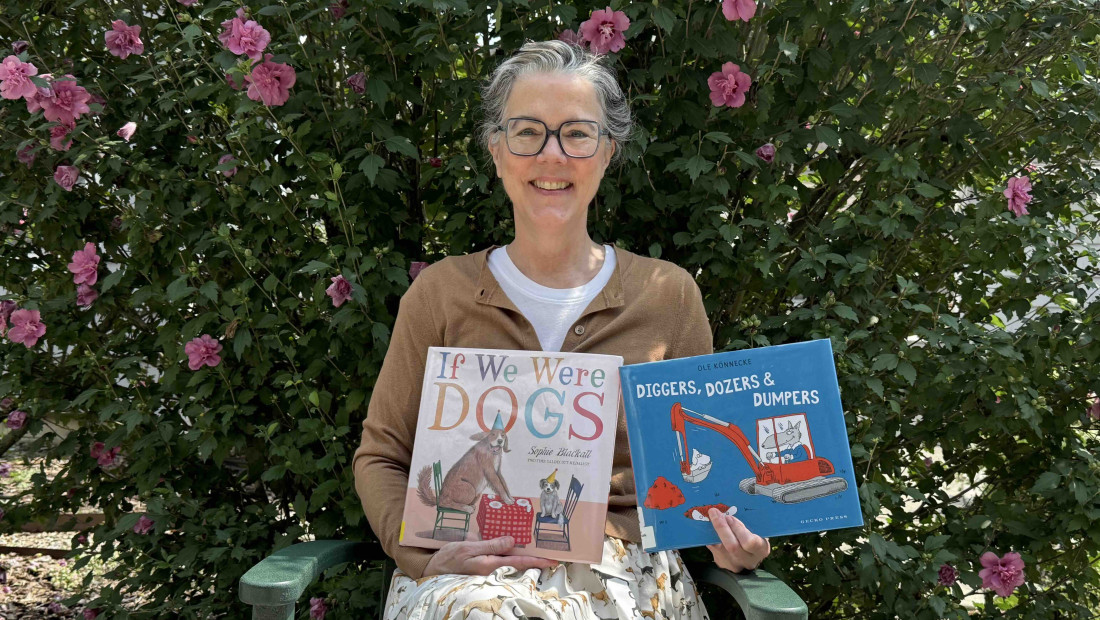
I fell in love with reading aloud picturebooks nearly 40 years ago, in my first year of teaching fourth grade, and I have been sharing them ever since, with children in classrooms, with teachers at conferences and with students at Ohio State.
The staff at my local library knows me well; I visit every week and leave with a towering stack.
Looking back over my favorite picturebooks published in 2025, one quality they had in common kept drawing my attention: they reward the adult reading aloud and the child listening in distinct ways.
The books featured here invite the adult reading aloud and the child listening into genuinely different experiences.
- A child delights in the absurdity of fish robots, while an adult catches the layered joke working beneath the surface.
- A child follows a little dog who finally speaks up, while an adult knows exactly how long it took her to get there.
- A child sees a butterfly’s transformation, while an adult sees three distinct artistic voices in conversation.
In each case, what makes these books remarkable is that both experiences are fully present in the same book.
The read-aloud is not just in service of the child’s encounter with the story; it is the adult’s encounter too.
Six picturebooks to engage and delight
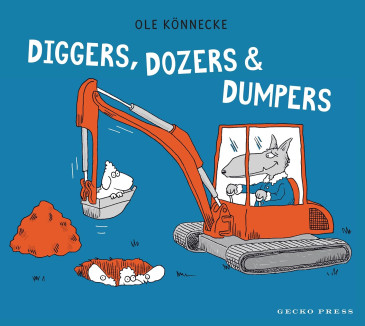
Diggers, Dozers & Dumpers
Written and illustrated by Ole Könnecke, translated by Melody Shaw. Gecko Press, 2025.
This is the book that inspired the theme of this entire list. Each full-page spread is devoted to a construction vehicle, with a brief factual description alongside a deadpan vignette.
Concert pianist Cordula Cow uses a telescopic crane to lower her piano into the pasture, where she plans to give a free concert for her less successful dairy cow sisters.
A rhinoceros whips up the most ambitious pancake recipe ever attempted in a cement mixer, requiring 32,304 eggs.
J.J. Wolf uses a mini digger to dig a hole in the sheep paddock, then extends a dinner invitation to the sheep now trapped inside it.
Children who know their excavators from their bulldozers will feel the particular satisfaction of a book that takes their knowledge seriously. But Könnecke’s comedy is invisible to anyone reading only for the machines.
The humor lives entirely in what the characters are doing with them. Catching it means holding the deadpan descriptions alongside the quietly ridiculous situations.
Könnecke never tips his hand, and that restraint is what makes the jokes land. The illustrations were drawn in fineliner on paper and digitally colored, each machine rendered with complete technical accuracy, while leaving the absurdity entirely to the text.
Diggers, Dozers & Dumpers received a rare starred review from The Horn Book Magazine and was named a 2026 Cooperative Children’s Book Center (CCBC) Choices selection.
Don’t Trust Fish
Written by Neil Sharpson, illustrated by Dan Santat. Dial Books for Young Readers, 2025.
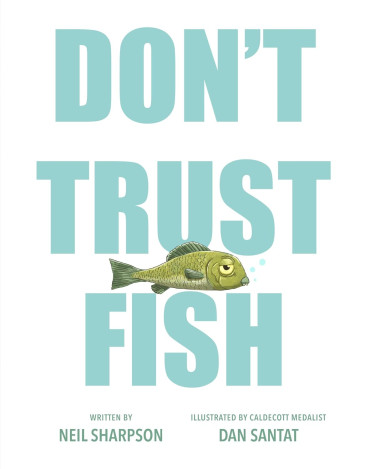
This book announces itself as a nature guide. It introduces a cow, a snake and a bird, each with a matter-of-fact identification.
Then, in bold type across the next full spread, it declares: “This is a FISH. DON’T TRUST FISH.”
From that point on, the book escalates with mounting paranoia, cataloguing the reasons fish cannot be trusted, from the suspicious curriculum of their “schools” to their apparent readiness to deploy giant robots against unsuspecting beachgoers.
The final pages reveal the narrator: a sheepish crab at a keyboard, exposed as the source of the fish conspiracy.
For a child, the fun is cumulative: each page adds another absurd charge against fish, and the final revelation that a crab has been narrating the whole time lands as pure comic surprise.
For an adult, there is a different kind of pleasure. The book lands a dead-on impression of a specific kind of voice, the breathless online conspiracy theorist who escalates without irony and recognizing that voice is what makes the escalation hilarious rather than merely silly.
Caldecott Medal and National Book Award winner Dan Santat created the art using pencil, watercolor and Adobe Photoshop, with visual jokes woven throughout, including a tiny skull in the dot of an exclamation point that rewards anyone looking closely.
Don’t Trust Fish received multiple starred reviews and was named the 2026 Bank Street College Irma Black Award Medalist, the 2026 Libby Book Award for Best Picture Book and the #1 K-2 pick in the Children's Book Council’s Kids Favorites program.
George & Lenny Are Always Together
Written and illustrated by Jon Agee. Rocky Pond Books, 2025.
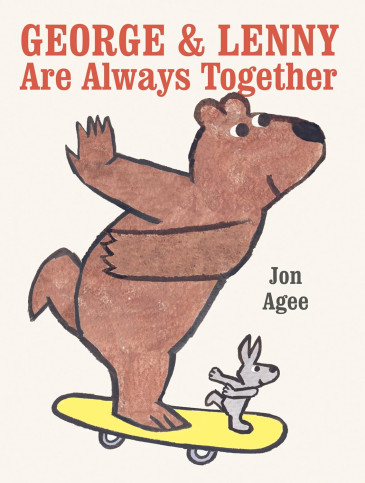
George is a bear. Lenny is a rabbit. They are always together, and George thinks this is terrific. Lenny is not so sure. When Lenny decides it’s time to find out what it feels like to be alone, George cannot understand why anyone would want such a thing.
After considerable negotiation, Lenny finds the perfect spot big enough for just one, where he draws, builds, plays music, reads a book and blows bubbles. When he finally calls out for George, he discovers that his friend has been on the roof right above him all along.
The ending earns its warmth because both friends discover that giving each other space is its own kind of togetherness. This is one of the oldest stories in children’s literature: two friends who are temperamentally different, working out how to be together on their own terms.
Children experience it as a funny story about a large, cheerful bear and a small, persistent rabbit who love each other and want different things. Adults who grew up with Frog and Toad will feel something familiar here, and not just because both books pair mismatched animal friends in quiet domestic situations.
Agee understands the same emotional logic Lobel perfected: some of the funniest and most touching friendship stories are about the friend who needs more, and the friend who loves them enough to try.
The gouache illustrations, outlined in bold black against minimalist backgrounds, render George’s oblivious cheerfulness and Lenny’s quiet persistence legible. A subtle structural choice reinforces the theme: George and Lenny never share a page until the very end, so when they finally do, the reunion needs no commentary.
George & Lenny Are Always Together was named a Junior Library Guild Gold Standard Selection.
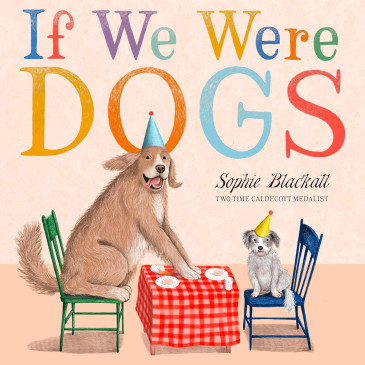
If We Were Dogs
Written and illustrated by Sophie Blackall. Little, Brown and Company, 2025.
Two friends are hiding under a table at a birthday party when one proposes the terms of a game: “If we were dogs, I’d be a big dog! And you’d be a little dog!”
What follows is a classic canine romp of tail wagging, stick fetching and hole digging, with a boisterous golden retriever leading and a small black-and-white dog following along with less and less enthusiasm. Finally, the little dog has had enough: “Being a dog is YOUR idea! Sometimes I HAVE IDEAS TOO!” How the big dog responds lies at the heart of the book.
Children experience the delight of imaginative play and the recognition of a friendship dynamic many of them know from the inside: the one where you are the little dog, going along with whatever the big dog decides, until you don’t.
Adults experience the negotiation underneath the play, the moment when one friend finds her voice and the other finds the grace to listen.
This book is a companion to the two-time Caldecott medalist’s 2023 If I Was a Horse, and Blackall brings the same attentiveness to the emotional life of children’s imaginative play.
The illustrations were made using digital pencils and gouache brushes in Procreate, superimposed over scanned vintage papers. They carry their own emotional current beneath the text, tracking the little dog’s reluctance in every sideways glance and hesitant wag, long before she changes the terms.
If We Were Dogs received multiple starred reviews, including a rare one from The Horn Book Magazine. It was named a 2026 ALSC Notable Book for Children and a PBS NewsHour Best Book of the Year. It also made the 2026 Bank Street College Best Children’s Books of the Year list.
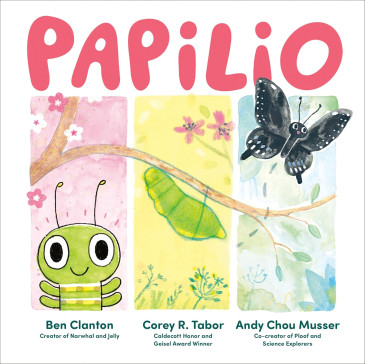
Papilio
Written and illustrated by Ben Clanton, Corey R. Tabor and Andy Chou Musser. Viking, 2025.
Papilio moves through the stages of metamorphosis in this collaboration between three book creators who set out to explore making a book together. Each of the three author-illustrators takes one stage of the journey: Ben Clanton tells the caterpillar’s story, Corey R. Tabor carries the chrysalis stage and Andy Chou Musser brings the butterfly to life. A mouse, originated by Tabor and woven into each stage, mirrors the friendship and collaboration of the three artists.
A child follows Papilio the way children follow any character whose journey pulls them forward. The metamorphosis story is familiar, but this telling of it is not, and even young readers will notice the book change texture as it moves through each artist’s unique style.
What an adult is also witnessing, however, is a second story running underneath: that transformation is not a single moment, but a process with visible seams, and that three friends telling one story together is its own kind of metamorphosis.
For the caterpillar section, Clanton combined pressings, stamps, crayons, pencils, ink, watercolors and etchings into a digital collage; Tabor digitally assembled pencil, colored pencil and watercolor art for the chrysalis stage; and Musser used gouache and colored pencil on watercolor paper, combined with digital paint and collage, to bring the butterfly to life.
Papilio received multiple starred reviews and was named a 2026 ALA Notable Children’s Book and a Kirkus Best Picture Book of 2025.
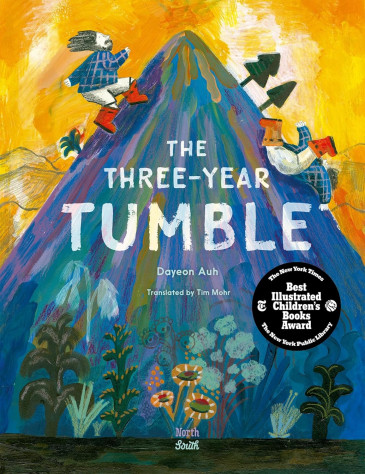
The Three-Year Tumble
Written and illustrated by Dayeon Auh, translated by Tim Mohr. NorthSouth Books, 2025.
Based on a traditional Korean folktale “Samnyeongogae” (Three-Year Mountain Pass), this picturebook introduces Misfortune Mountain, a peak so treacherous that anyone who tumbles down it is said to have only three years left to live.
When Grandfather takes a tumble, he is convinced his time is up. While visiting him on his sickbed, his granddaughter sees the numbers another way: if tumbling down once means just three years to live, then tumbling down again and again should add years rather than subtract them. Convinced, Grandfather leaps from his sickbed and heads straight back to the mountain, tumbling down again and again, until the whole village follows. What was once a dire warning becomes a gleeful invitation.
Everyone accepts the legend without question; only the granddaughter does the arithmetic. A child experiences that as the thrill of watching a clever child solve the problem the adults could not, which is one of the most satisfying story traditions in all of children’s literature.
An adult is likely to feel something else alongside that thrill: perhaps recognizing themselves among the adults who never thought to question the legend, and the delight of a folktale whose upside-down logic turns out to be true in the way the best folktales are.
Auh’s exuberant mixed-media illustrations carry a playful, uninhibited energy that suits a story whose wisest character is the youngest one in the room.
The Three-Year Tumble was named a 2026 ALA Notable Children’s Book, a 2025 New York Times/New York Public Library Best Illustrated Children’s Book, a Smithsonian Magazine Best Children’s Book of 2025 and a 2025 United States Board on Books for Young People (USBBY) Outstanding International Book.
Summing it up
Each of these 2025 picturebooks offers something different to every reader in the room, and that difference is the point.
A child and an adult sitting with the same book are not having the same reading experience: they are noticing different things, laughing for their own reasons and bringing entirely different histories to the same page.
That layered experience is the result of deliberate craft. I hope these titles find their way into your hands, your laps and your read-aloud repertoire, bringing as much pleasure to the grown-ups in the room as they do to the children listening.
Lisa Pinkerton is a clinical associate professor in the Department of Teaching and Learning within the College of Education and Human Ecology at The Ohio State University. She specializes in literature for children and young adults and is one of five authors of Charlotte Huck’s Children’s Literature: A Brief Guide, a foundational text in children’s literature courses.
Previous columns in this series:
Pinkerton, L. (2025, July 31). Lisa’s list: Pairs of picturebooks for rich conversation.
Pinkerton, L. (2024, July 2). Lisa’s list: Picturebooks to foster deep thinking.


