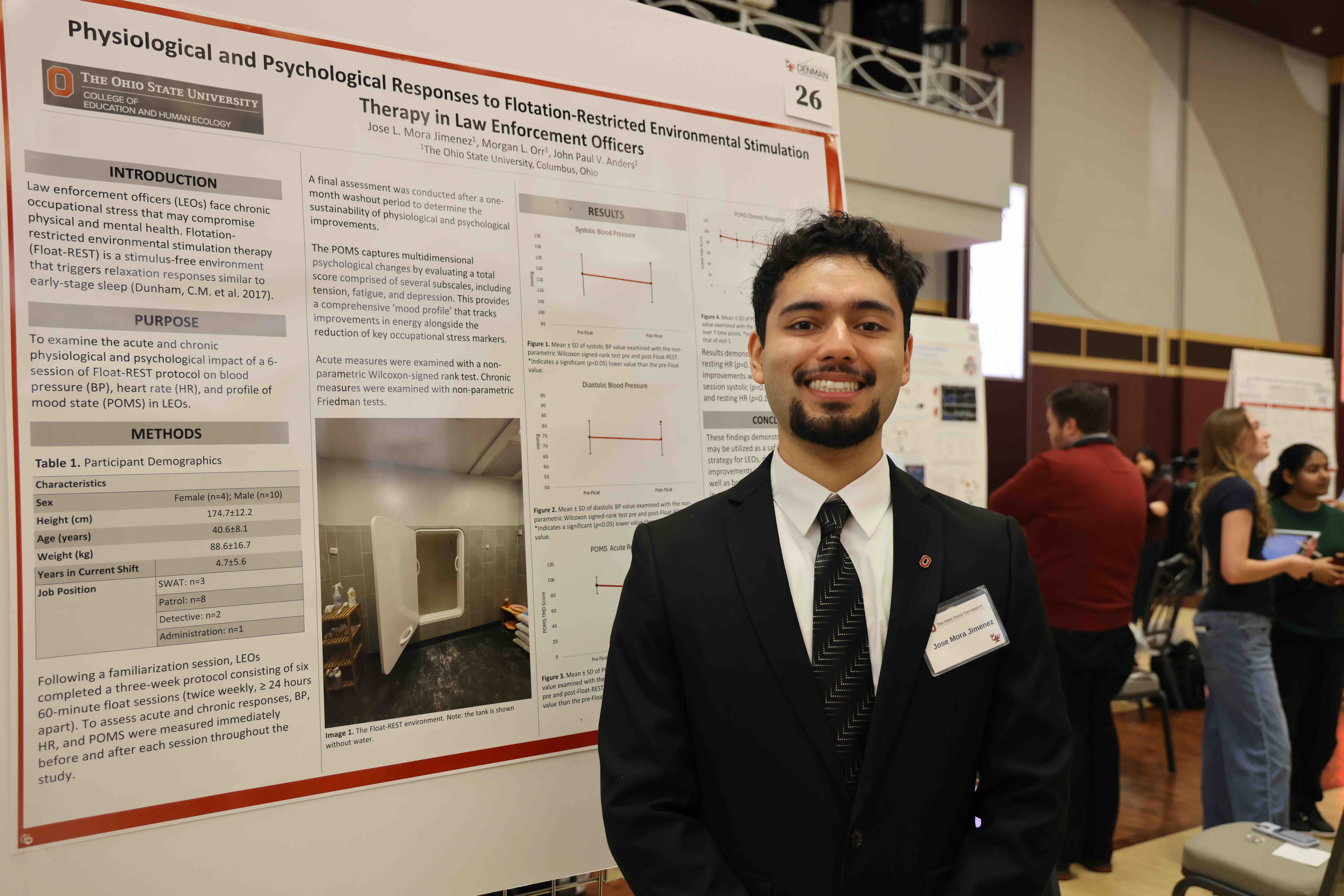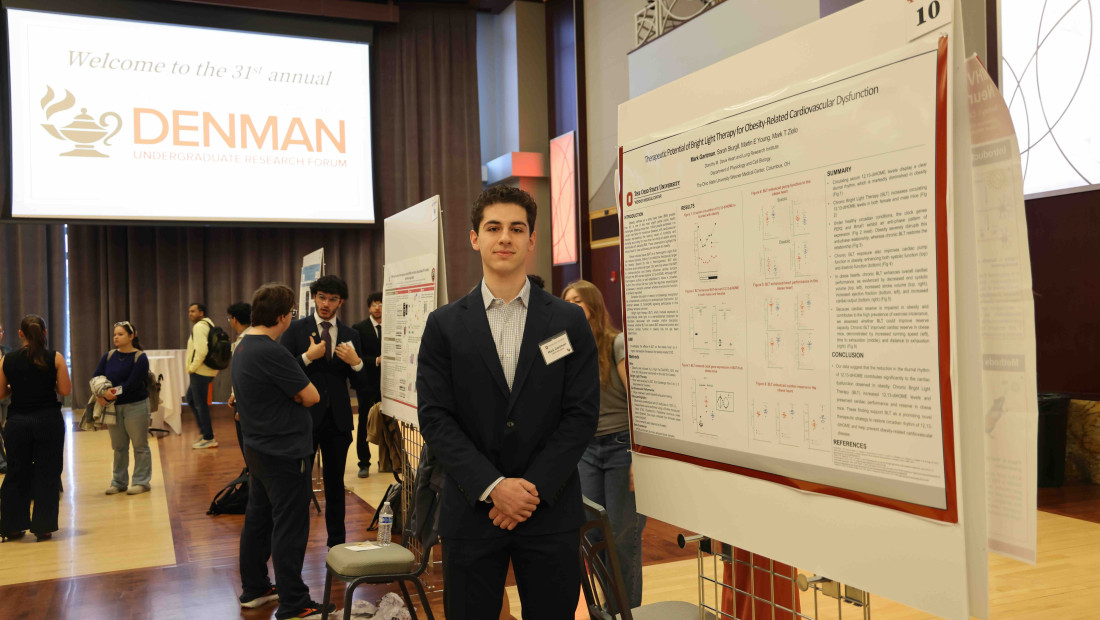
Mark Gantman, an exercise science major in the college, presented his research at the Denman Forum. Students may seek research mentors from across the university to broaden their expertise. Gantman conducted his study with College of Medicine Professor Mark Ziolo on how light therapy affects cardiovascular dysfunction
This spring, Ohio State’s Columbus campus became a hub of discovery as undergraduate students, graduate students and postdoctoral scholars presented their original research at two annual forums. Their studies, conducted with their university mentors, spanned multiple disciplines.
Their topics ranged from the ability of artificial intelligence to recognize accents among English speakers to the effects of caffeine consumption on student-athletes.
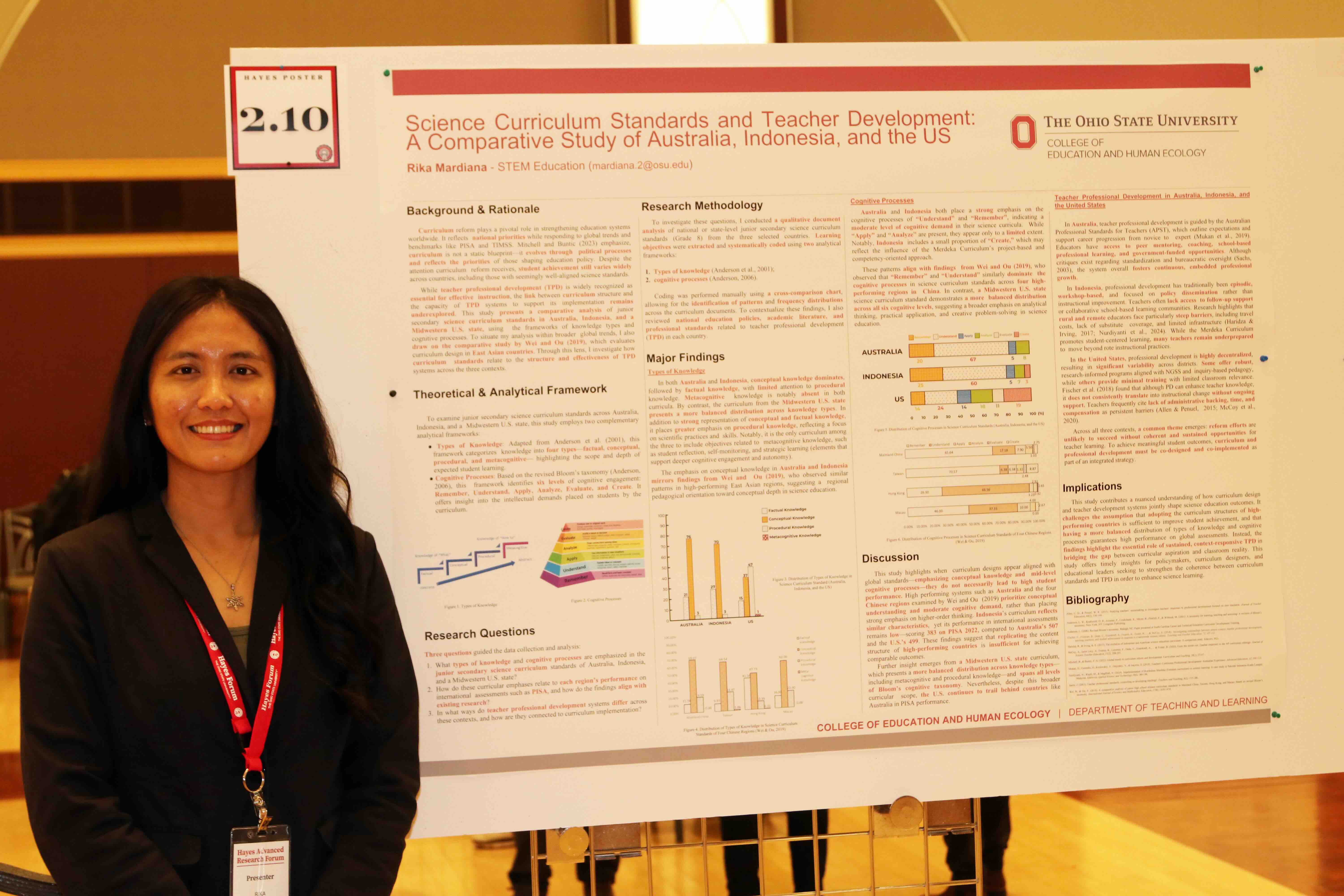
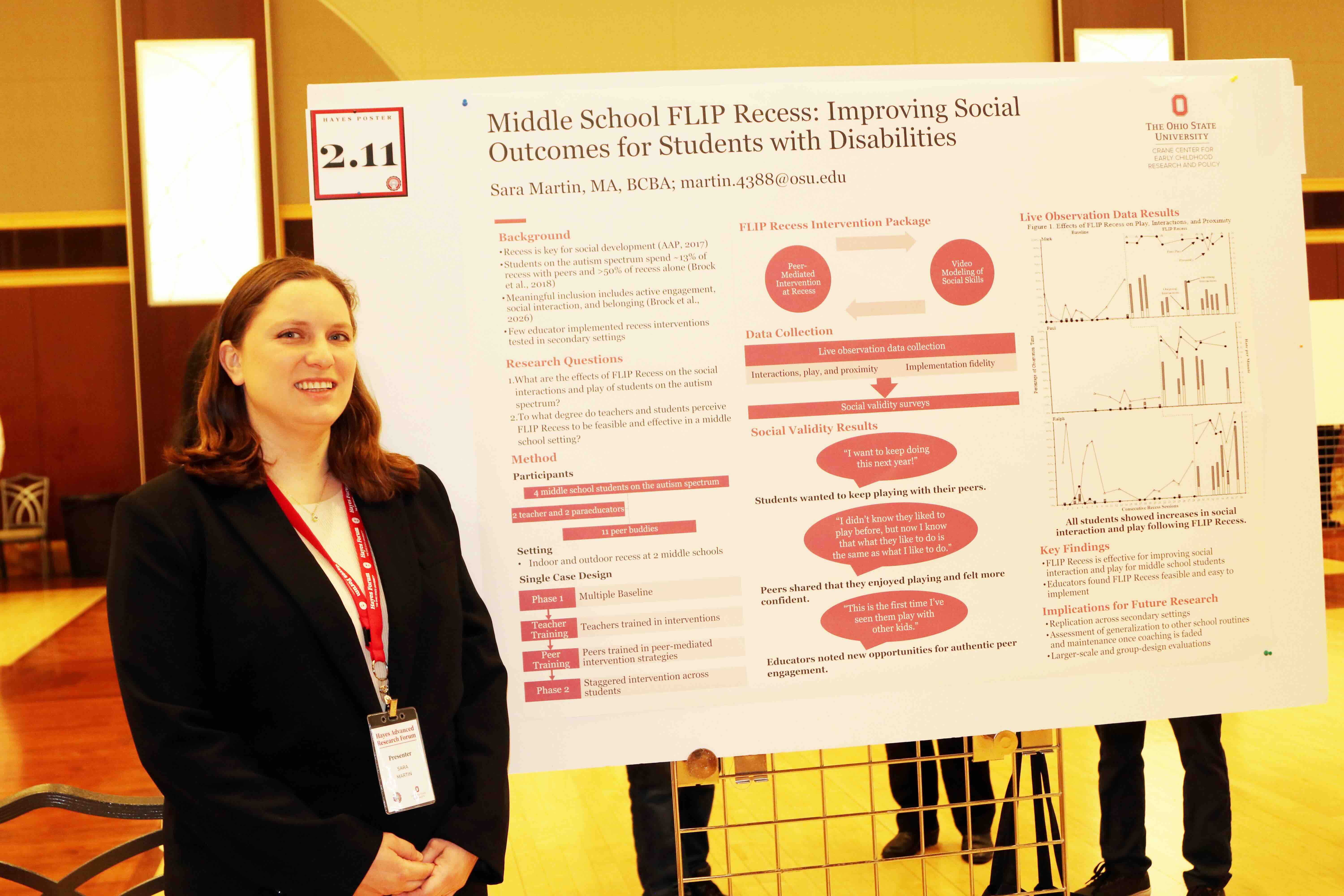
The Edward F. Hayes Advanced Research Forum, held recently at the Ohio Union, featured research by graduate students and postdoctoral scholars.
The event offered “an exciting opportunity for you to showcase your commitment to excellence in research, and to demonstrate to your peers and the Ohio State community your commitment to the highest caliber scholarship,” President Ravi V. Bellamkonda said in his greeting to participants.
“Through your studies, interactions with your professors and mentors and your leadership of younger Buckeyes, you are advancing the ideals that make Ohio State a hub for innovation and an academic powerhouse.”
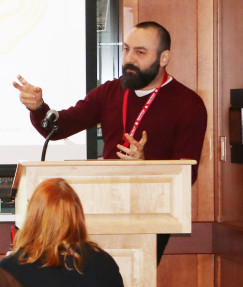
Onur Özkaynak, a graduate student in the Department of Teaching and Learning in the college, presented his research exploring how AI tools interpret the accents of users with accents.
His presentation expounded on his doctoral dissertation, in which he researched the accuracy of AI in interpreting the English language as spoken by people with accents from various parts of the world.
“AI tools have been very influential in the last couple of years. They’re everywhere and are also [present] in educational tools,” he said. “I became interested in the language ideologies behind these tools.”
“So that’s why I wanted to explore and understand what kind of ideologies they hold and what kind of assumptions they make about different speakers of English.”
Undergraduate excellence shines at all-day research forum
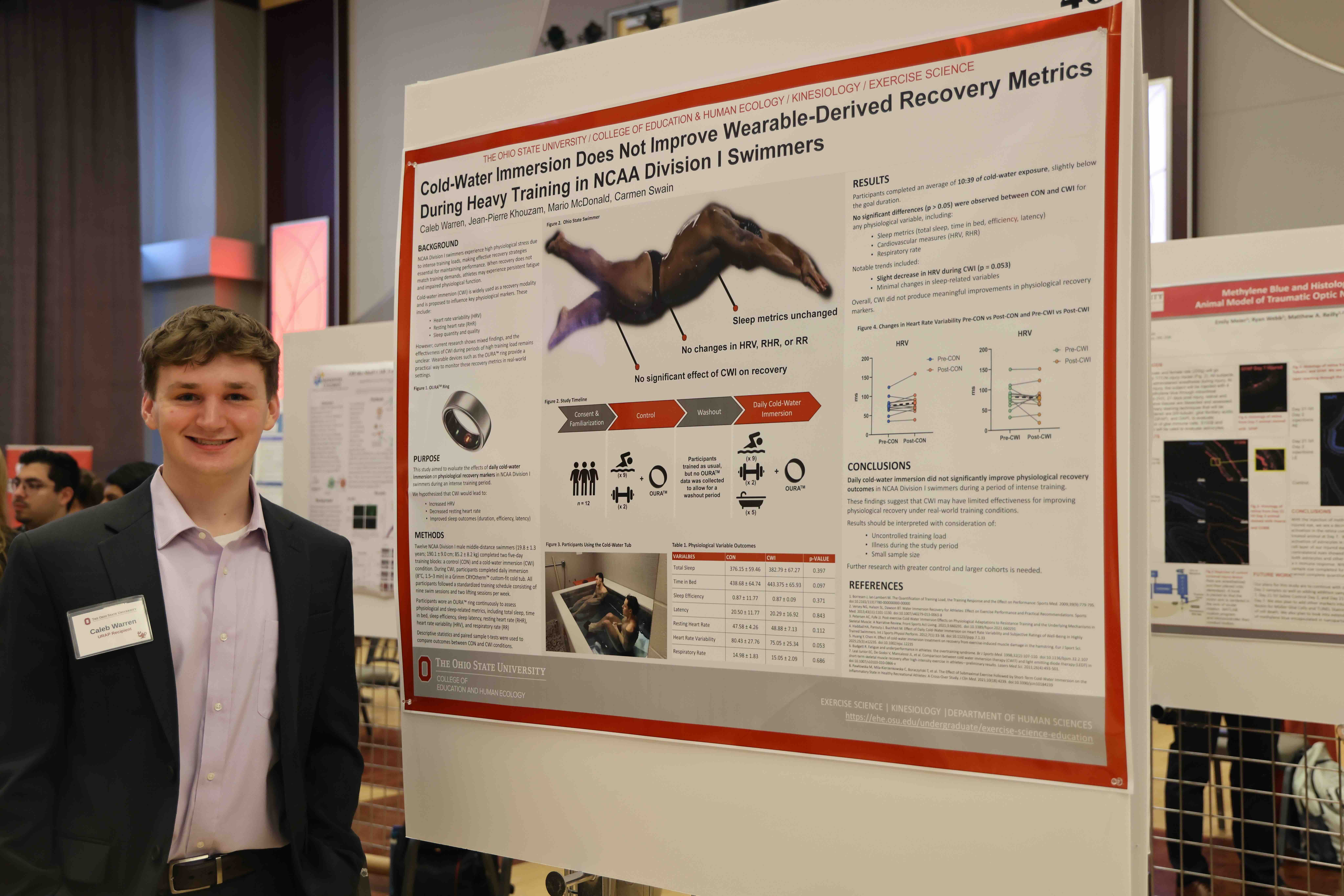
The Richard J. and Martha D. Denman Undergraduate Research Forum, also held at the Ohio Union, showcased undergraduate students’ research.
Anna Hewitt, a human nutrition major in the college, conducted a survey that found 75% of student-athletes consume caffeine more than four to six times a week.
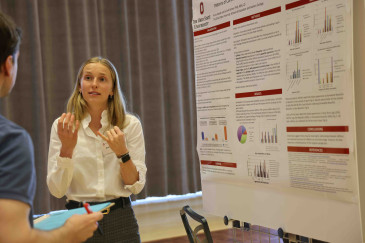
“What I found so far is that female athletes do believe that caffeine suppresses feelings of hunger,” she said. “They also think that they can possibly skip meals.”
Hewitt explored the connections between caffeine consumption and student-athletes’ body image.
“What I thought was interesting is when I correlated the two, all the caffeine drinkers who consume caffeine two to three times a week actually thought they were beautiful,” she said. “What I’m going to do is a statistical analysis and find out what really underlines the connection between these two.”
Kasey Stammen, an exercise science major also in the college, studied the effectiveness of a procedure known as the Y Balance Test to measure the stability, range of motion and injury risk of patients who are being treated in physical therapy clinics.
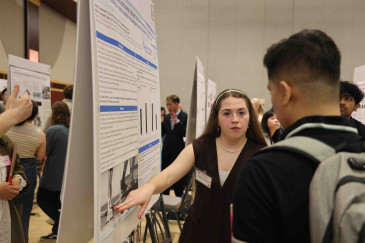
As part of her research, “I actually went to an outpatient physical therapy clinic, and I learned about Y Balance Tests in an anatomy class that I had,” Stammen said. “It was great tying in my injury prevention background with my exercise science education.”
Stammen said her research project enabled her to put concepts she learned in class into practice.
“I started at Ohio State as a data analytics major and I ultimately thought, I love data, but I want to do something more with it rather than just analyze it. So, I switched to exercise science, and I thought, I want to know why people are getting injured,” she said.
“There are a lot of people in exercise science who want to know the best humans can be, and I want to know why humans are so fragile.”
All photos courtesy of The Ohio State University