
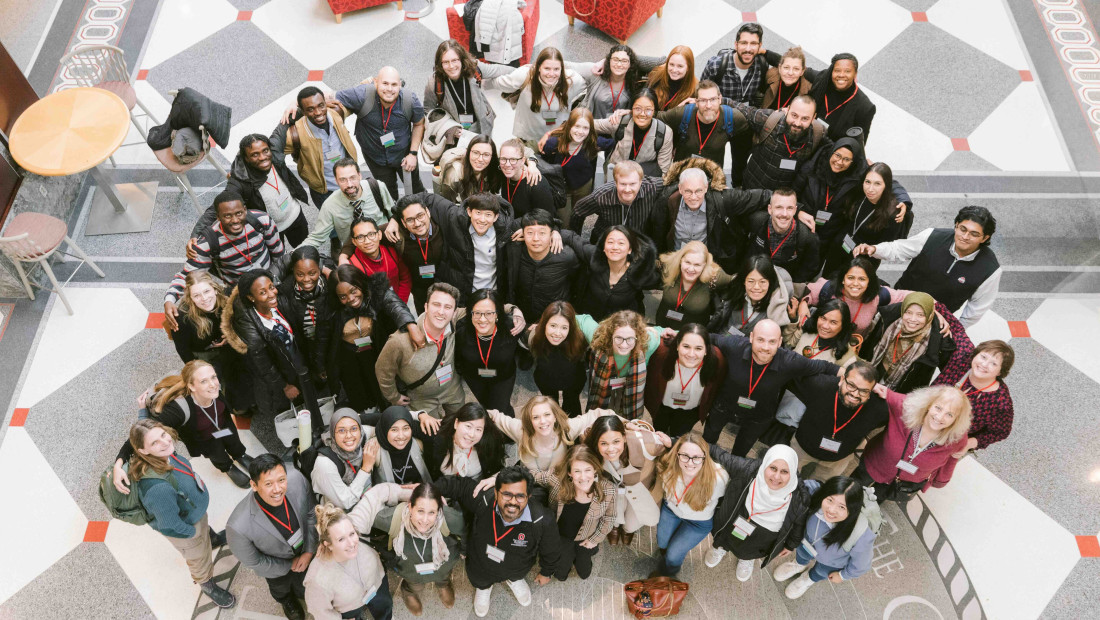
Professor Penny Pasque, front row, middle, plaid jacket, black top, served as keynote speaker at the college’s 2025 Research Forum. Here she is with some of the college’s many students (and a few faculty) who attended the forum.
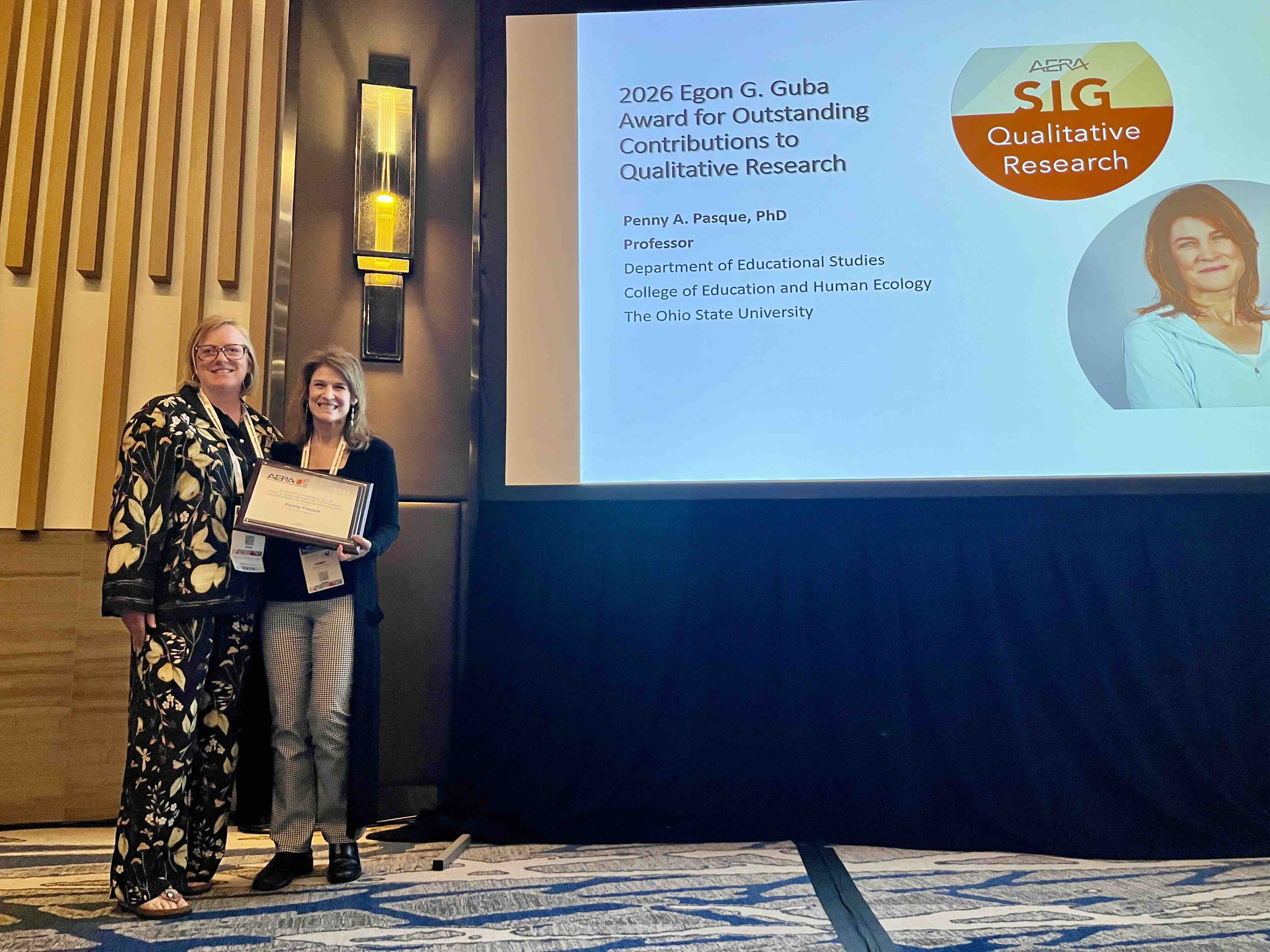
The Egon G. Guba Award — one of the highest honors in qualitative educational research — is typically reserved for scholars whose work has shaped the field over decades.
This year, the distinction goes to Penny Pasque, professor of higher education and student affairs. She also is:
- founding director of the QualLab Research Center at Ohio State
- program coordinator for and developer of qualitative courses (ESQUAL) for the Department of Educational Studies
- course developer and creator of the college’s Qualitative Inquiry in Education Graduate Certificate.
Her extraordinary influence, breadth of scholarship and leadership have marked her as a defining voice in qualitative inquiry at a relatively early stage in her career.
The award, presented by the Qualitative Research Special Interest Group of the American Educational Research Association at April’s annual conference, recognizes how her influential scholarship is innovating the education field’s approach to thinking about and applying qualitative research.
It also recognizes her guiding influence on multiple disciplines in using qualitative methods to innovate their research.
Qualitative research is a systematic approach to inquiry that seeks to understand how people make meaning of their experiences, actions, interactions and social contexts. It uses methods such as interviewing, focus groups, organizational observations, policy report analysis and researcher reflexivity.
“A nationally recognized scholar of qualitative and critical research methodologies, Penny has built an exceptional record of influence through her extensive publications, methodological innovation and mentorship of scholars across generations,” Erik Porfeli, interim dean of the college, said.
“Since she arrived in 2019, her work has helped redefine how qualitative research is designed, conducted and used — while advancing the rigor, legitimacy and public impact of this inquiry in education, as well as in other disciplines such as sociology, medicine and public policy.”
“This national recognition affirms the breadth and significance of her influence and affirms our legacy of excellence in qualitative research in EHE.”
Pasque’s impact as a scholar
“Dr. Penny A. Pasque is considered one of the leading qualitative research experts in education and human sciences,” wrote nominator Michelle Salazar Pérez, the Velma E. Schmidt Endowed Chair for Early Childhood Education, College of Education, University of North Texas.
To support the nomination, Pérez gathered seven letters of support from other members of the association’s Qualitative Research Special Interest Group, as well as letters from current and former students.
Pérez described Pasque as building an extensive body of work that provides “significant and impactful contributions to the development and thinking related to qualitative methodological practice in education.”
For example, Pasque has written, edited, co-written or co-edited 13 books and “published over 100 peer-reviewed journal articles, books and handbook chapters in the content area of qualitative inquiry, higher education and related areas,” wrote Pérez.
Rozana Carducci, graduate director and associate professor at the Dr. Jo Watts Williams School of Education, Elon University, wrote in her nomination that several of Pasque’s books, for example a text from Routledge, Qualitative Inquiry in Higher Education Organization and Policy Research, have become essential references for students, researchers and practitioners.
“While Dr. Pasque’s extensive record of high-quality, peer-reviewed publications and scholarly presentations firmly establishes her as a leading scholar of qualitative methodology,” Carducci wrote, “it is her unwavering advocacy for methodological inclusion and innovation that most powerfully reflects the Egon Guba Award’s aim to ‘promote the use of research to improve education and serve the public good.’”
Nominator Kakali Bhattacharya, professor of research, evaluation and measurement, College of Education, University of Florida, summed up Pasque’s scholarship impact. “Dr. Pasque’s extensive body of work exemplifies the transformative potential of qualitative inquiry, advancing both its methodologies and its applications within educational research.”
Sustained leadership, guiding others in qualitative scholarship
Nominators pointed repeatedly to Pasque’s national and international influence beyond her own publications. Her personal scholarship is intrinsically bound to her ongoing efforts to promote the work of colleagues in the field.
A leading example is her editorship of The Review of Higher Education, a top journal in the field.
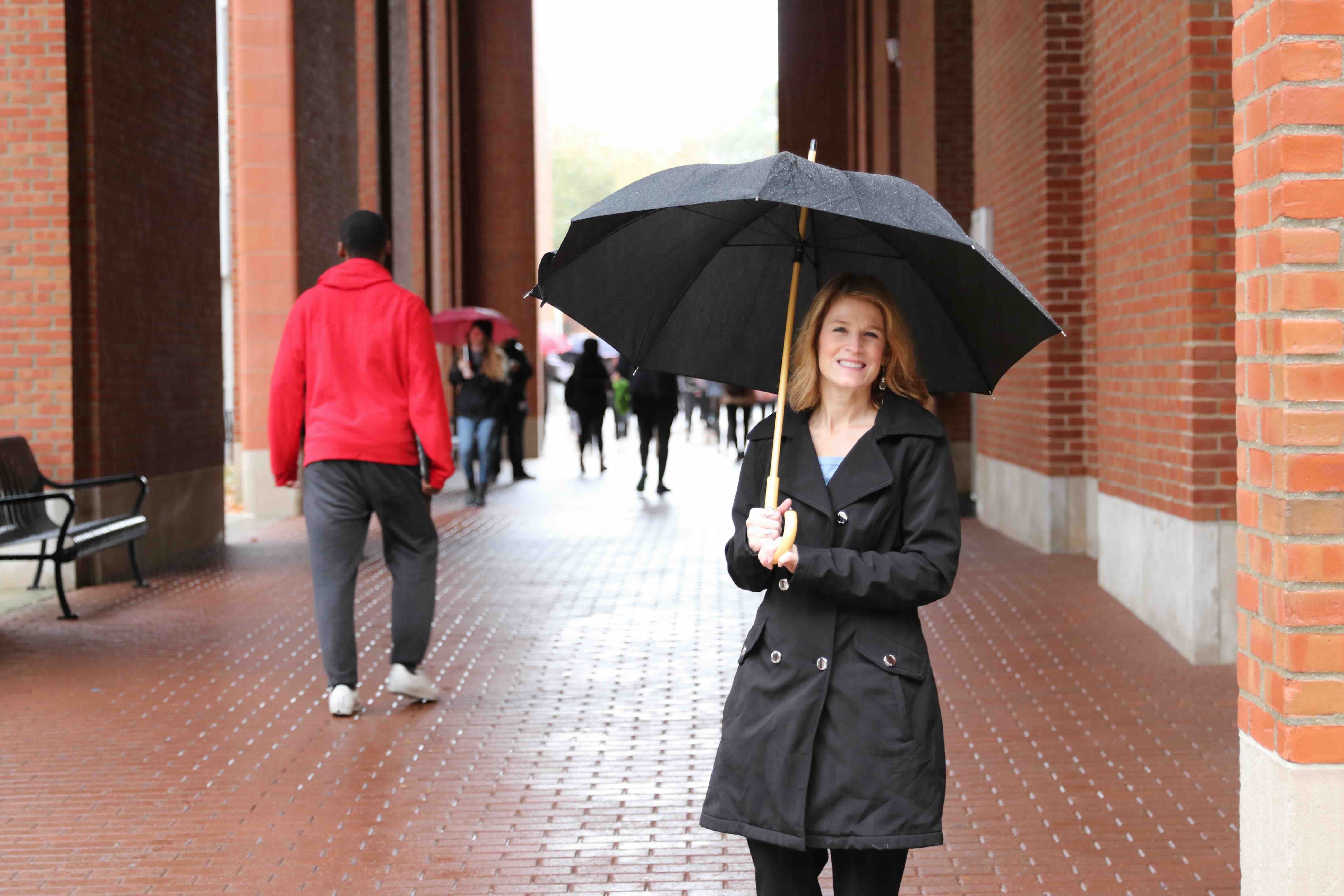
In that role, she ensures that articles representing innovation and excellence are published.
In her edited books, “Dr. Pasque curates a rich collection of chapters from a (wide) group of methodological scholars,” Carducci wrote. In her authored and edited work, “her commitment to publishing methodological texts that chart new terrain has inspired both emerging and established qualitative scholars to explore innovative approaches.”
“I would like to honor the vital role Dr. Pasque’s editorial leadership has played in shifting qualitative research from niche publication outlets to top-tier, high-impact journals.”
“Her leadership has created pathways for qualitative researchers to reach broader audiences, amplifying the impact of their work and cementing qualitative research as an essential component of academic scholarship.”
Reshaping the field through sustained capacity building, mentorship
A defining reason for Pasque’s selection is her commitment to building innovative, action- oriented, qualitative research communities, wrote nominator Leslie C. Moore, associate professor in the Multilingual Language Education program, Department of Teaching and Learning at Ohio State.
Moore refers to Pasque as “a catalyst for community, creating spaces where qualitative researchers thrive and diverse voices are centered in knowledge production.”
Case in point: Upon arrival at Ohio State, Pasque founded the QualLab, an internationally engaged research center dedicated to innovation in qualitative research.
Noelle Arnold, senior associate dean at Ohio State’s College of Education and human Ecology, wrote that “the QualLab has become a ‘destination’ resource for qualitative and mixed methods.”
Pasque also developed the Qualitative Inquiry in Education Certificate at Ohio State. Students across the university take these courses or the entire certificate to build their expertise.
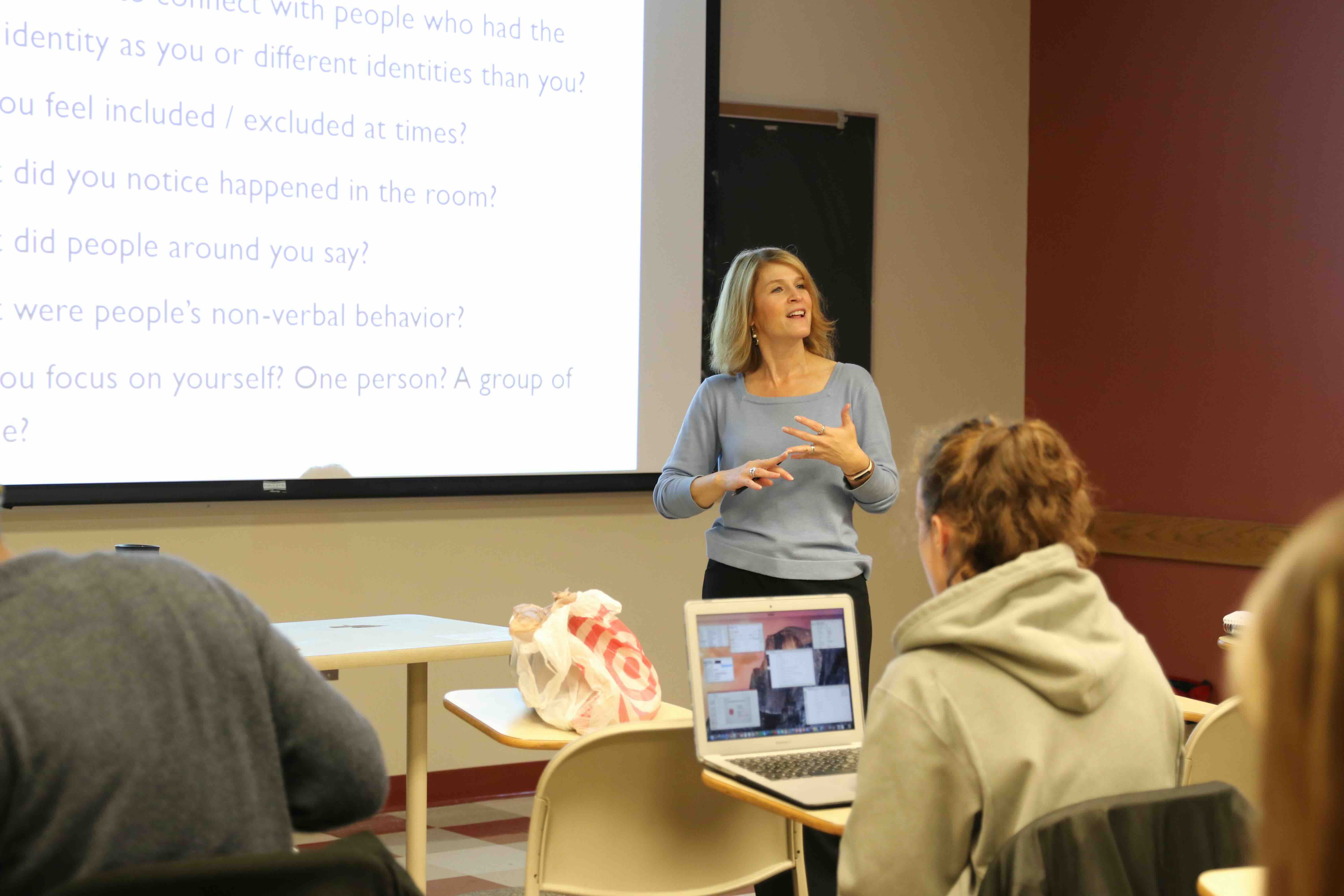
“In the field, Pasque has connected with the International Congress of Qualitative Inquiry (ICQI) every summer at the University of Illinois,” wrote Patti Lather, faculty emeritus of the college and a Guba Awardee, “as well as working … to start the Critical Qualitative Special Interest Group at the congress some years ago.”
Pasque’s interdisciplinary reach on grant projects is another hallmark of her work. She has led or contributed to qualitative components of large‑scale, externally funded projects, including multi‑million‑dollar collaborations involving scholars in education, health, neuroscience, policy and emerging areas such as artificial intelligence.
Her expertise is sought by federal agencies, foundations and policymakers. She has consulted on research funded by the National Science Foundation and National Institutes of Health.
She consistently demonstrates the value of qualitative inquiry within interdisciplinary teams, unlocking the strength of this specialized research approach for others, so they may display deeper understanding of the subjects they’re investigating.
For example, she serves as co-principal investigator on a $4.3 million grant focused on concussion-related vision problems among military personnel and others (scroll down in the linked story).
Equally significant is Pasque’s role as a mentor and teacher, which reflects the generational reach of her work.
Three of her mentees wrote a nomination: Z Nicolazzo, interim associate dean of Faculty Affairs and professor, University of Arizona; Moira Ozias, assistant professor of Educational Policy Studies and Practice, University of Arizona; and Erin Simpson, assistant vice president and assistant dean of students, University of Oklahoma.
They each specified how Pasque nurtured opportunities for them. Nicolazzo wrote that Pasque invited her to write a chapter in her 2024 book, present through the QualLab and be a section editor for her 2025 encyclopedia-like book from Routledge.
“In an academic world that often desires individualism and competition, Penny has created a relationship with me that has felt altogether different,” wrote Nicolazzo. “I am incredibly thankful to Penny for providing a different model of being in and of the academic work of qualitative methods.”


